Fixed Price vs Hourly: Which Outsourcing Model Saves More?
When outsourcing software development, one of the first financial decisions you may face is how to pay for the work.
Should you agree on one price before development begins? Or should you pay according to the hours your outsourced team actually works?
The fixed price vs hourly decision can affect far more than the final invoice. It influences flexibility, project risk, budgeting, change management, and even how your team works with its outsourcing partner.
At first glance, fixed pricing may seem like the safer option because you know the cost upfront. Hourly billing can appear less predictable because the final cost depends on the time required.
But cheaper on paper does not always mean better value.
Choosing the right outsourcing pricing model depends on how clearly your project can be defined, how likely requirements are to change, and how much flexibility you need during development.
Topic Breakdown
What Is Fixed Price Outsourcing?
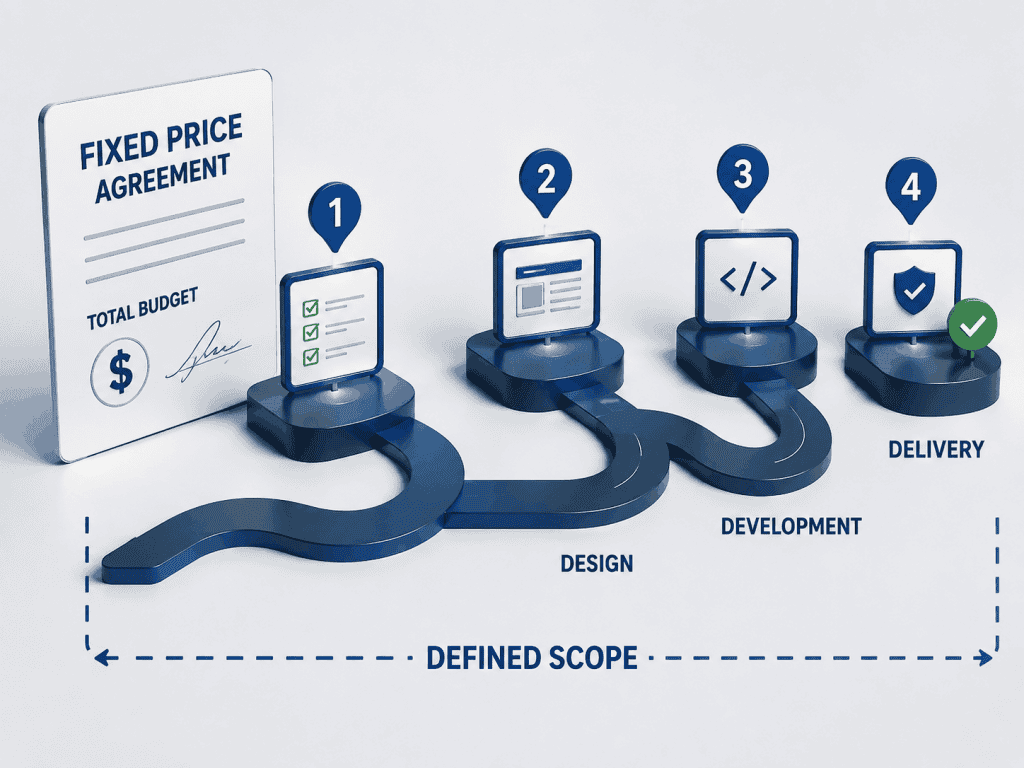
Under a fixed price model, the client and outsourcing provider agree on a defined project scope, timeline, deliverables, and price before development begins.
Once the agreement is finalized, the provider is generally responsible for completing the agreed work within that budget.
The basic principle is similar to a firm-fixed-price contract, where the agreed price is not adjusted simply because the contractor’s actual costs turn out to be higher than expected.
For example, imagine a business wants a customer portal with:
✅ User registration and login
✅ Account management
✅ A dashboard
✅ Payment integration
✅ Basic reporting
✅ A defined set of administrative features
If all requirements can be documented clearly before development begins, an outsourcing company may estimate the work and quote one total project price.
Fixed price works best when the destination is already clear.
What Is Hourly Billing in Outsourcing?
With hourly billing, the client pays according to the amount of development time used.
The outsourcing provider may set different hourly rates for developers, designers, QA engineers, project managers, or other specialists.
This approach is often associated with a time-and-materials model. In formal contracting terminology, time-and-materials arrangements bill labor using agreed hourly rates, while labor-hour arrangements are a variation where the contractor is not supplying materials.
For software development, the practical idea is straightforward:
You pay for the resources and development time your project actually needs.
Hourly billing remains a common outsourcing pricing option when requirements may evolve, priorities may change, or the full scope cannot realistically be determined at the beginning.
Fixed Price vs Hourly: Quick Comparison
Factor
Fixed Price
Hourly Billing
Budget predictability
High for agreed scope
Variable
Scope flexibility
Lower
High
Upfront planning
Extensive
Moderate
Changes during development
Usually require scope adjustments
Easier to accommodate
Client involvement
Often milestone-based
Usually more continuous
Best for
Clearly defined projects
Evolving or complex projects
Cost risk
More predictable initially
Depends on hours used
Ability to reprioritize
Limited
Strong
Suitable for Agile development
Possible, but requires careful structure
Often easier to manage
In the fixed price vs hourly decision, neither model is automatically cheaper.
What matters is whether the pricing model matches the type of work being outsourced.
Understanding how each outsourcing pricing model handles uncertainty is important when comparing potential savings.
When Fixed Price Can Save More
Fixed pricing can be highly cost-effective when the project is predictable.
If the outsourcing team can accurately estimate the work, there is less uncertainty to manage throughout development.
Your Requirements Are Already Clear
Fixed pricing becomes easier when features, workflows, integrations, designs, acceptance criteria, and technical requirements have already been documented.
The fewer unanswered questions there are, the easier it is for a development partner to provide an accurate estimate.
Your Budget Has a Firm Limit
Some businesses need to know exactly how much a project will cost before approving it.
A fixed price agreement provides a clear budget for the defined scope, which can make internal approvals and financial planning easier.
The Project Is Relatively Small
A landing page system, a defined website migration, a simple internal tool, or a limited application feature may be easier to estimate than a large platform with multiple integrations and evolving requirements.
Smaller, well-bounded projects usually contain fewer unknowns.
Requirements Are Unlikely to Change
Fixed price works best when everyone is confident that the original specifications will remain relevant throughout development.
If the project can move from requirements to delivery without major changes, the client gains budget certainty without sacrificing much flexibility.
When Fixed Price Can Cost More Than Expected
The fixed price itself may not change, but that does not mean the project is protected from additional costs.
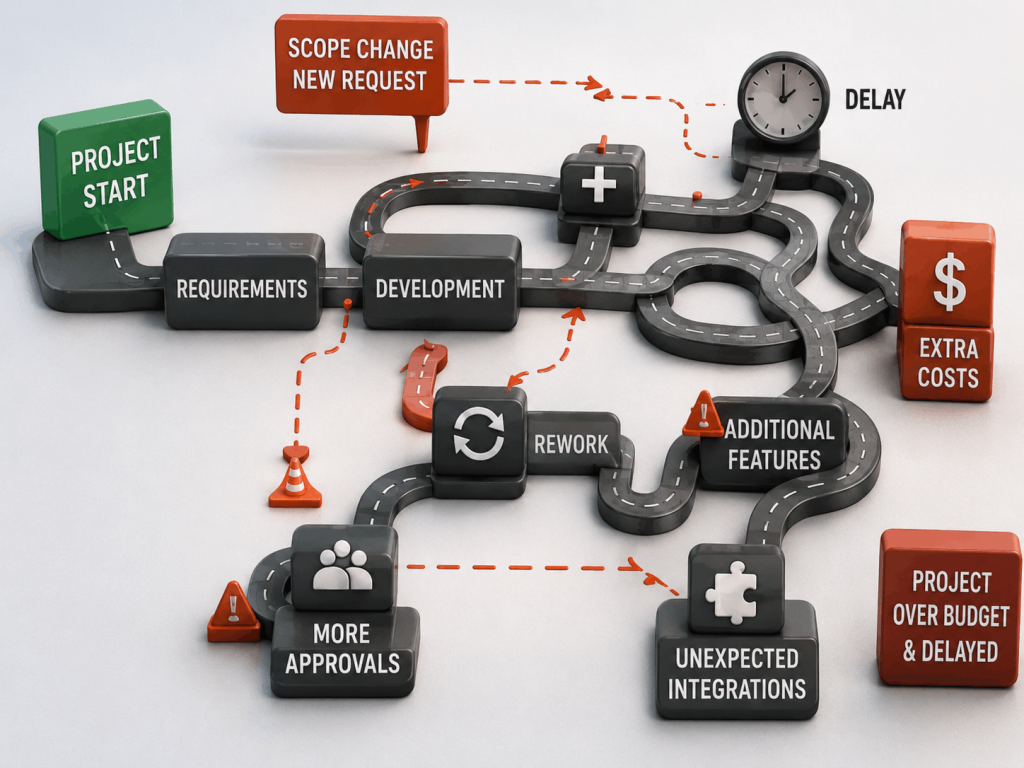
The biggest issue is usually scope change.
Suppose development begins and users suddenly need a different checkout workflow, a new integration, additional permissions, or a redesigned dashboard.
If those features were not included in the original agreement, they may require a change request, a revised quotation, or a separate development phase.
A project can therefore begin with a fixed budget but accumulate additional costs as the scope evolves.
There is also another factor to consider.
Under this outsourcing pricing structure, the vendor assumes more risk when requirements are uncertain. That uncertainty may be reflected in the original quotation. Project-management guidance generally recognizes that fixed-price agreements transfer more cost risk to the seller, while time-and-materials arrangements leave more cost uncertainty with the buyer.
You may effectively be paying for predictability.
That can still be worthwhile, but it is important to understand what the fixed price actually covers.
When Hourly Billing Can Save More
Hourly billing sometimes sounds more expensive because there is no single guaranteed total.
In practice, it can reduce unnecessary spending when a project contains uncertainty.
Your Product Is Still Evolving
Many software products change after users, stakeholders, or internal teams begin testing them.
New priorities emerge. Features become less important. Better solutions are discovered.
An hourly arrangement allows the development team to adjust without renegotiating the entire project every time priorities change.
You Want to Launch an MVP First
Startups often do not need every planned feature in version one.
They need enough functionality to test the idea.
With hourly development, the team can prioritize the highest-value features, launch an MVP, gather feedback, and then decide what should be built next.
This can prevent money from being spent on features users ultimately do not need.
Technical Unknowns Exist
Some projects involve legacy systems, undocumented APIs, third-party integrations, migrations, or technical problems that cannot be fully assessed before development begins.
Trying to force uncertain work into a fixed estimate can result in either an inflated quotation or repeated change requests.
Hourly billing allows the team to investigate and respond as more information becomes available.
Your Priorities Change Frequently
Modern software development often involves continuous prioritization.
The Scrum framework, for example, treats the Product Backlog as something that can evolve as teams learn more about the product and stakeholder needs.
If your business expects priorities to change during development, a flexible pricing structure may make those decisions easier.
The Hidden Cost of Choosing the Wrong Pricing Model
The cheapest hourly rate or lowest fixed quotation does not necessarily produce the lowest total project cost.
A poor pricing fit can create expenses that are less obvious at the beginning.
Consider a fixed-price project where requirements are incomplete.
Development starts. New requirements appear. The team pauses to estimate them. Change requests are prepared. Stakeholders approve additional costs. Development resumes.
That process can happen repeatedly.
Now consider an hourly project with weak management.
The team works continuously, priorities are unclear, unnecessary features are built, and nobody closely reviews the hours being used.
That project can also become expensive.
The problem in both cases is not simply the pricing model.
It is the combination of the pricing model, project clarity, governance, communication, and development process.
Which Model Provides Better Budget Control?
When comparing fixed price vs hourly billing, the two models provide different forms of budget control.
Fixed price provides stronger cost certainty.
Hourly billing provides stronger spending control during development when managed properly.
Those are not necessarily the same thing.
With fixed pricing, you know how much the agreed deliverables should cost.
With hourly billing, you can decide where the team’s next hours should be spent.
For example, an hourly development team may discover that one planned feature offers little business value. You can remove it from the backlog and redirect development time elsewhere.
Under a fixed scope, changing priorities may be more complicated.
For businesses building products that are expected to evolve, the ability to control priorities can sometimes create more savings than knowing the entire project price from day one.
The best outsourcing pricing approach often becomes clearer once you consider the type of software work involved. Different types of software work naturally favor different models.
A Clearly Defined Corporate Website
Likely fit: Fixed price
If the sitemap, designs, functionality, integrations, and content requirements have already been agreed upon, the project can usually be estimated with reasonable confidence.
A New SaaS Product
Likely fit: Hourly
New SaaS products often change after prototypes, testing, and customer feedback. Flexibility may be more valuable than locking the entire roadmap into one early specification.
A Small Feature With Detailed Requirements
Likely fit: Fixed price
A clearly isolated feature can often be scoped and estimated without introducing significant uncertainty.
Legacy Software Modernization
Likely fit: Hourly
Older systems frequently contain technical dependencies that only become visible after developers begin examining the codebase.
Ongoing Software Improvements
Likely fit: Hourly
Continuous updates, bug fixes, integrations, optimization, and feature development are difficult to package into one permanent fixed scope.
Can You Combine Fixed Price and Hourly Billing?
Yes.
Businesses do not always need to choose one model for the entire outsourcing relationship.
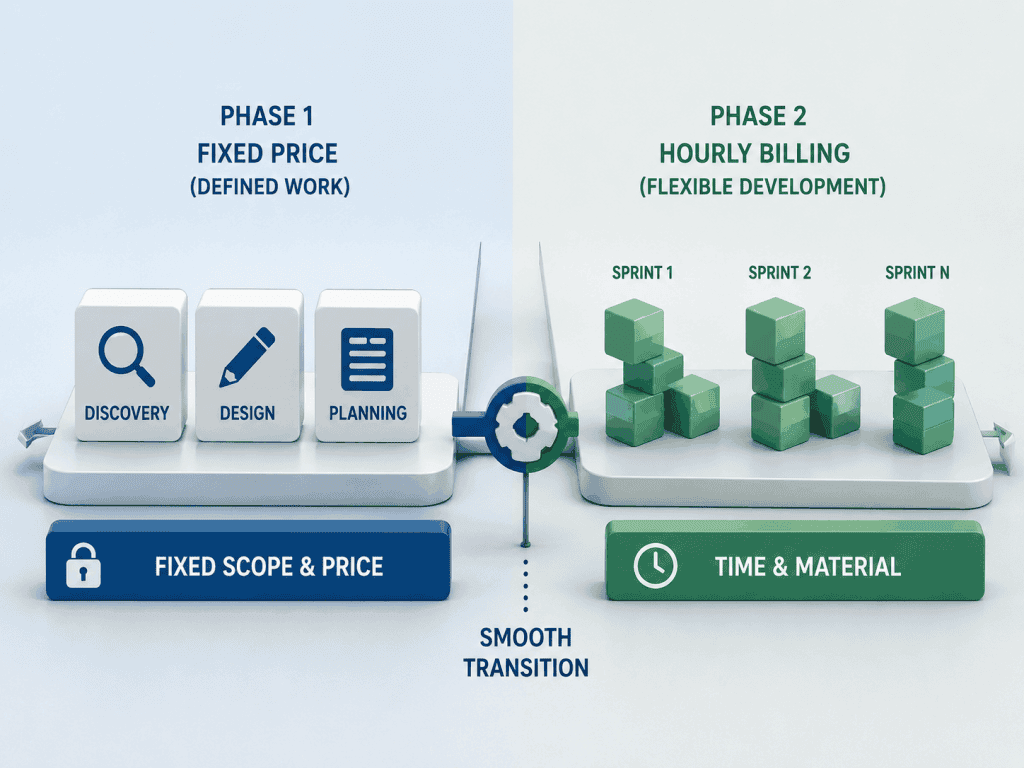
A flexible outsourcing pricing strategy can also combine both models, using fixed pricing for clearly defined phases and hourly billing for work that requires more adaptability.
For example, you might use a fixed price for the discovery or design phase, then move to hourly billing once active product development begins.
Another option is to use hourly billing with a monthly budget ceiling.
You can also divide a large project into smaller phases and agree on fixed pricing only when each phase becomes clearly defined.
This allows the commercial structure to change as project uncertainty changes.
The important point is that the contract should support the project rather than forcing the project to fit the contract.
Questions to Ask About Outsourcing Pricing
Before choosing between fixed price vs hourly billing, ask:
✅ Can we describe the required product in detail today?
✅ How likely are our requirements to change?
✅ Are there technical unknowns that still need investigation?
✅ Is our priority strict budget certainty or development flexibility?
✅ How involved do we want to be in prioritizing work?
✅ Are we building a one-time project or an evolving product?
✅ How will changes to scope be priced and approved?
✅ How will development hours or project progress be reported?
The answers usually make the right model much clearer.
So, Which Model Actually Saves More?
There is no universal winner in the fixed price vs hourly comparison.
Fixed price can save money when requirements are stable, the project is well understood, and the business values predictable spending.
Hourly billing can save more when requirements are uncertain, priorities are expected to change, or the team needs room to experiment and adapt.
The more uncertainty a project contains, the harder it becomes to estimate everything accurately at the beginning.
In those situations, paying for controlled development time can sometimes be more efficient than paying for a fixed scope filled with assumptions and contingency.
For predictable work, the opposite may be true.
The best outsourcing pricing model is therefore not necessarily the one with the lowest quote.
It is the one that reduces unnecessary risk, rework, administration, and wasted development effort.
Choosing the Right Outsourcing Partner Matters Too
Pricing is only one part of a successful outsourcing relationship.
A reliable development partner should help you understand where uncertainty exists, explain what is included in the estimate, communicate how changes will be handled, and recommend an outsourcing pricing model that suits the project.
Be cautious when a provider pushes every project into exactly the same pricing structure.
Different projects require different levels of flexibility.
A good outsourcing partner should be comfortable discussing the trade-offs before development begins.
Choosing between fixed price and hourly billing should not come down to which quotation looks cheaper.
Start with your project.
If the scope is clear and unlikely to change, fixed pricing can provide valuable budget certainty.
If your software needs to evolve as you learn, hourly billing can provide the flexibility to spend development resources where they create the most value.
The goal is not simply to minimize the amount you pay per hour or lock in the lowest possible project price.
It is to choose an outsourcing model that helps you build the right product without unnecessary cost or friction.
Whether you need a defined development project or flexible access to experienced software specialists, the right engagement structure can help you get more value from your outsourcing investment.
FAQs
Is fixed price cheaper than hourly outsourcing?
Not necessarily. Fixed price can be more cost-effective for clearly defined projects with stable requirements. Hourly billing may cost less when requirements are likely to change because the team can adjust priorities without repeatedly renegotiating the entire scope.
What is the difference between fixed price and hourly billing?
Fixed price sets an agreed cost for a defined scope of work. Hourly billing charges according to the amount of development time used. Fixed pricing prioritizes predictability, while hourly billing generally provides greater flexibility.
Which pricing model is best for software outsourcing?
The best outsourcing pricing model depends on the project. Fixed pricing usually works well for predictable, clearly scoped work. Hourly pricing is often more suitable for evolving products, complex development, ongoing improvements, and projects with technical uncertainty.
Is hourly billing risky for outsourcing?
Hourly billing can create budget risk if hours and priorities are not managed carefully. Businesses can reduce this risk through regular reporting, clear backlogs, budget limits, sprint planning, and frequent progress reviews.
Can outsourcing companies offer both fixed price and hourly models?
Yes. Many outsourcing relationships can use different pricing structures depending on the project or development phase. Some businesses also use hybrid arrangements, such as fixed pricing for clearly defined phases and hourly billing for ongoing development.
How do I prevent an outsourced software project from going over budget?
Start with clear priorities, agree on how progress and costs will be reported, review development regularly, define how scope changes will be approved, and make sure both your internal team and outsourcing partner understand who can authorize additional work.
🚀 Ready to discuss your next software project?
At Lanex, we work with businesses to build practical software solutions around their technical requirements, business goals, and preferred way of working.
Compare staff augmentation cost with in-house hiring and uncover the hidden expenses behind recruitment, benefits, onboarding, turnover, and team growth.
Explore the key staff augmentation benefits for growing businesses, from faster access to skilled talent to flexible scaling and better project delivery.
Learn practical steps for IP protection when outsourcing software development, including contracts, access controls, source code ownership, and offboarding.
Avoid common outsourcing mistakes with practical outsourcing tips for choosing the right partner, setting expectations, and managing software projects well.