How to Protect Your IP When Outsourcing Software Development
IP protection when outsourcing software development should be planned before an external developer sees your source code, product roadmap, customer data, or technical documentation.
Outsourcing can give your business access to specialized talent, faster development, and more flexible delivery. However, it also means sharing valuable information with people outside your organization. Without clear ownership terms and appropriate security controls, disagreements may arise over who owns the software, who can reuse parts of it, and what happens to your information when the project ends.
Protecting intellectual property does not mean avoiding outsourcing. It means structuring the relationship correctly from the beginning.
Here is how businesses can protect their ideas, source code, data, and other proprietary assets when working with an outsourced software development team.
Note: This article provides general business information and is not legal advice. Intellectual property laws differ by country and state. Consult qualified legal counsel when drafting or reviewing an outsourcing agreement.
Topic Breakdown
What Intellectual Property Is Involved in Software Development?
Intellectual property in a software project includes more than the finished application.
Depending on the project, your IP may include:
➡️ Source code and object code
➡️ Product concepts and business logic
➡️ Algorithms and machine learning models
➡️ User interface and user experience designs
➡️ Databases and data structures
➡️ Technical documentation
➡️ Product roadmaps and feature plans
➡️ Internal processes and workflows
➡️ Customer or operational data
➡️ Brand assets, names, and visual elements
➡️ Trade secrets and confidential business information
Some of these assets may already belong to your business before development begins. Others will be created during the engagement.
Your contract should clearly distinguish between the two.
Why IP Protection When Outsourcing Matters
An outsourced development team may need access to repositories, cloud environments, databases, design files, product specifications, and internal systems. That access is often necessary to complete the work, but it also increases the number of people and tools involved in handling sensitive information.
Common risks include:
➡️ Unclear ownership of newly created source code
➡️ Unauthorized reuse of code or designs
➡️ Excessive access to systems and data
➡️ Undisclosed subcontractors working on the project
➡️ Developers using unapproved open-source components
➡️ Project files being stored in personal accounts
➡️ Confidential information remaining with the provider after the contract ends
➡️ Disputes involving different countries or legal jurisdictions
1. Identify Your Intellectual Property Before Sharing It
Start by identifying what information and assets the development team will need.
Classify them according to their level of sensitivity. For example:
Classification
Examples
Recommended Access
Public
Published product information and public APIs
May be shared when required
Internal
General workflows and project documentation
Limited to the assigned team
Confidential
Product plans, customer data, and architecture
Strict role-based access
Highly Restricted
Proprietary algorithms, credentials, and trade secrets
Access only when essential
This exercise helps you decide what should be shared, who should receive it, and what controls should apply.
Do not give every developer access to the entire product environment simply because they are working on one part of the project.
2. Evaluate the Outsourcing Partner Carefully
Strong agreements are important, but they work best when paired with a trustworthy development partner.
Before selecting a provider, ask how it handles
✅ Employee and contractor confidentiality
✅ Developer background checks
✅ Source code repositories
✅ Access permissions
✅ Passwords and credentials
✅ Personal devices
✅ Remote work environments
✅ Security incidents
✅ Employee departures
✅ Subcontractors
✅ Open-source software
✅ Client information after project completion
The provider should be able to explain its process clearly. Vague statements such as “we take security seriously” are not enough.
Ask who will work on the project, where the work will be performed, and whether any part of it may be passed to another company or independent contractor.
When comparing staff augmentation and managed services, also consider who will supervise developers, control system access, and remain accountable for security throughout the engagement.
3. Sign a Confidentiality Agreement Before Disclosure
A nondisclosure agreement, or NDA, should be signed before you share sensitive product information.
The agreement should define:
✅ What information is confidential
✅ How the information may be used
✅ Who may access it
✅ How long confidentiality obligations continue
✅ Whether the provider can disclose information to subcontractors
✅ What happens if information is exposed
✅ How confidential materials must be returned or destroyed
An NDA helps establish expectations, but it should not be your only safeguard.
Trade secret protection generally depends on the owner taking reasonable steps to keep information secret. WIPO identifies confidentiality agreements as one of the measures businesses can use when sharing sensitive information with vendors, consultants, and other partners.
Limit what you disclose even after the NDA is signed. Information should only be shared when it is necessary for the assigned work.
4. Define IP Ownership in the Main Contract
Never assume that paying for software automatically gives you ownership of every part of it.
The outsourcing agreement should expressly state who owns:
✅ The final source code
✅ Designs and prototypes
✅ Technical documentation
✅ Databases and schemas
✅ Test scripts
✅ Configuration files
✅ Custom integrations
✅ Inventions and discoveries
✅ Project-specific tools
✅ Modifications and derivative work
In the United States, copyright ownership can be transferred through a written agreement signed by the party transferring the rights. Possessing a copy of the software does not, by itself, transfer the underlying copyright.
The contract should therefore include a clear intellectual property assignment rather than relying only on general language stating that the client has paid for the work.
Have legal counsel review the wording, especially when developers or providers are based in another jurisdiction.
5. Separate Background IP From Project IP
Most experienced software providers use existing knowledge, frameworks, libraries, templates, and internal tools to deliver projects efficiently. It may not be reasonable for the client to own everything the provider created before the engagement.
The contract should distinguish between:
Background IP
Background IP includes assets that existed before the project or were developed independently from it.
Examples include:
✅ Reusable development frameworks
✅ Internal deployment tools
✅ Pre-existing code libraries
✅ Standard templates
✅ General development methods
The provider may retain ownership of these assets while granting the client the license needed to use them within the finished product.
Project IP
Project IP, sometimes called foreground IP, includes materials created specifically for your project.
Examples include:
✅ Custom source code
✅ Project-specific designs
✅ Unique business logic
✅ Custom documentation
✅ Proprietary integrations
The agreement should state whether this IP is assigned to the client and when that assignment takes effect.
Separating these categories prevents future disagreements while allowing the development provider to continue using its general expertise.
6. Keep Critical Accounts Under Your Control
Whenever practical, your business should own the accounts and environments that contain critical project assets.
These may include:
➡️ Source code repositories
➡️ Cloud hosting accounts
➡️ Domain registrations
➡️ App store accounts
➡️ Analytics platforms
➡️ Design workspaces
➡️ Project management tools
➡️ CI/CD pipelines
➡️ Database services
➡️ Third-party API accounts
Developers can be granted access without becoming the permanent owners of the accounts.
Using client-controlled environments reduces vendor lock-in and makes it easier to change team members or providers without losing access to code, infrastructure, or project history.
It also helps ensure that the latest version of the product remains available to your organization throughout development, rather than being delivered only at the end.
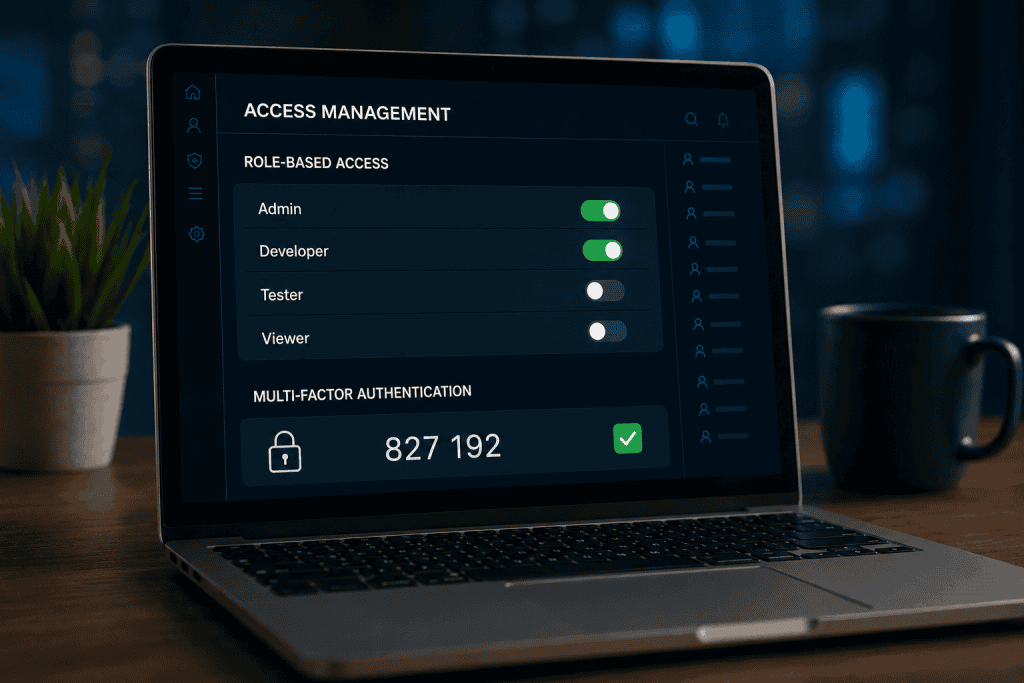
7. Apply Least-Privilege Access
Each team member should receive only the access required for their responsibilities.
A user interface developer, for example, may not need unrestricted access to production databases. A quality assurance specialist may not need administrator rights to your cloud environment.
Use controls such as:
✅ Role-based permissions
✅ Multifactor authentication
✅ Unique user accounts
✅ Temporary access
✅ IP or device restrictions where appropriate
✅ Repository branch protections
✅ Audit logs
✅ Password management tools
✅ Regular access reviews
Avoid sharing one administrator account among multiple developers. Shared accounts make it harder to determine who performed a particular action and prevent you from revoking access for one person without affecting the rest of the team.
8. Build IP Protection Into Software Development
Effective IP protection in software development is not limited to keeping information private. The development process must also protect the integrity and traceability of the software being created.
Your outsourced team should follow a secure development process that includes:
✅ Version control
✅ Peer code reviews
✅ Automated security testing
✅ Dependency scanning
✅ Documented releases
✅ Secure configuration management
✅ Backup and recovery procedures
✅ Vulnerability remediation
✅ Separation of development and production environments
The NIST Secure Software Development Framework recommends integrating security practices into the software development lifecycle rather than treating security as a separate final-stage activity.
A well-managed development history also helps establish who created specific components, when they were created, and how they were changed.
9. Set Rules for Open-Source and Third-Party Components
Modern software is rarely built entirely from scratch. Developers commonly use open-source packages, commercial libraries, software development kits, APIs, and cloud services.
These tools can accelerate development, but they come with licenses and usage conditions.
Require the development provider to:
✅ Use approved components
✅ Keep an inventory of major dependencies
✅ Review relevant license obligations
✅ Avoid components with incompatible terms
✅ Document commercial third-party services
✅ Notify you before introducing critical dependencies
✅ Monitor known vulnerabilities
✅ Replace unsupported components when necessary
For higher-risk or regulated projects, consider requesting a software bill of materials, or SBOM, that lists the components used in the application.
CISA’s software acquisition guidance encourages organizations to evaluate supplier practices and software supply-chain risks before acquiring or relying on software.
10. Address AI-Assisted Development
Developers may use AI coding assistants to generate suggestions, explain code, create tests, or speed up documentation.
Your agreement or project policy should clarify:
✅ Whether AI coding tools are permitted
✅ Which tools have been approved
✅ Whether proprietary code may be entered into external AI systems
✅ How generated code will be reviewed
✅ How licensing and security concerns will be assessed
✅ Whether developers must disclose AI-generated contributions
Do not assume that every AI tool handles prompts, source code, or account data in the same way.
Sensitive code, customer information, credentials, and unpublished product details should not be submitted to unapproved external tools.
The provider you hire may not always perform every part of the work directly.
Your contract should state whether subcontracting is permitted and whether the provider must obtain written approval before adding another individual or company.
Approved subcontractors should be bound by confidentiality, IP assignment, security, and data-handling obligations that are at least as protective as the main agreement.
You should also know:
✅ Who the subcontractors are
✅ Where they are located
✅ What systems they can access
✅ What work they will perform
✅ When their access will end
Responsibility should remain with the primary outsourcing provider, even when part of the project is delegated.
12. Include Security Incident Requirements
Your agreement should explain what happens if source code, credentials, customer data, or confidential information is exposed.
Define:
✅ What qualifies as a security incident
✅ How quickly the provider must notify you
✅ Who will investigate
✅ What information must be provided
✅ How access will be contained
✅ Who is responsible for remediation
✅ How evidence and system logs will be preserved
✅ Whether customers or authorities may need to be notified
The provider should not wait until every detail is known before informing you that a serious incident may have occurred.
Early notification gives your internal team more time to protect systems and reduce potential damage.
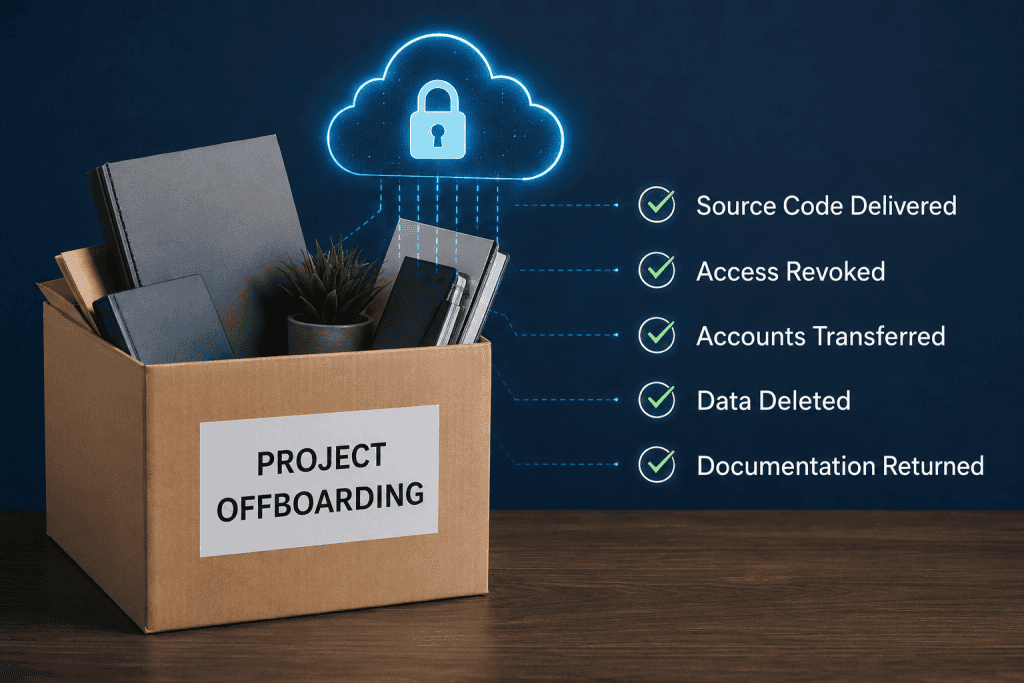
13. Plan the Offboarding Process in Advance
IP protection should continue when the project or outsourcing relationship ends.
Create an offboarding checklist covering:
✅ Delivery of the latest source code
✅ Transfer of documentation
✅ Transfer of administrative accounts
✅ Removal of developer access
✅ Rotation of passwords and credentials
✅ Return of devices or physical materials
✅ Deletion of local project copies
✅ Removal of customer and production data
✅ Confirmation that subcontractor access has ended
✅ Written certification of deletion when appropriate
✅ Ongoing confidentiality obligations
Do not delay these actions until weeks after the final invoice or product launch.
Access should be removed promptly when a developer leaves the project, even if the broader provider relationship is continuing.
Common IP Protection Mistakes to Avoid
Businesses often expose their intellectual property through preventable mistakes.
Watch for these warning signs:
Relying Only on an NDA
An NDA protects confidentiality, but it does not necessarily establish ownership of newly created software.
Using Vague Ownership Language
Terms such as “all deliverables belong to the client” may not adequately define source code, documentation, reusable components, inventions, or third-party materials.
Allowing the Provider to Own Every Account
This can leave your company dependent on the provider for access to repositories, hosting, domains, and application listings.
Giving the Entire Team Administrator Access
Broad permissions increase the effect of mistakes, compromised accounts, and unauthorized actions.
Ignoring Open-Source Licenses
A freely available library may still include conditions affecting distribution, modification, attribution, or disclosure.
Waiting Until the End to Request the Source Code
Your company should have ongoing access to the repository and development history.
Failing to Address Subcontractors
A strong agreement with the main provider offers limited protection if other developers can access the project without equivalent obligations.
This checklist will not eliminate every risk. It will, however, give your business stronger control over its software and the information used to build it.
Protect Your IP Without Slowing Development
Outsourcing and intellectual property protection are not opposing goals.
The right structure allows outside developers to do their work efficiently while your business maintains control over its code, accounts, confidential information, and product direction.
Effective protection combines three elements:
Clear agreements that define ownership and confidentiality
Technical controls that limit and monitor access
Operational processes that govern development, subcontracting, and offboarding
Whether you need a complete development team or additional expertise for an existing project, a well-structured engagement can help you move forward without losing control of your critical assets.
Who owns software created by an outsourced development team?
Ownership depends on the applicable law and the terms of the outsourcing agreement. Do not assume that paying for development automatically transfers every intellectual property right. The contract should clearly identify the deliverables and include an appropriate written IP assignment reviewed by legal counsel.
Is an NDA enough to protect software intellectual property?
No. An NDA helps protect confidential information, but it does not address every ownership, licensing, access, subcontracting, or security issue. It should be used alongside a detailed development agreement and appropriate technical controls.
How can a business protect its source code when outsourcing?
Keep the code in a client-controlled repository, require unique user accounts and multifactor authentication, restrict permissions, maintain backups, enable audit logs, and retain continuous access to the development history. Access should be revoked promptly when a team member leaves.
Is offshore software development safe for intellectual property?
It can be. The location of the development team is only one consideration. Businesses should evaluate the provider’s agreements, security processes, hiring practices, access controls, subcontractor policies, and the laws that apply to the engagement.
What should an outsourcing contract say about intellectual property?
The contract should address ownership of deliverables, source code assignment, background IP, licensing, confidentiality, subcontractors, open-source components, AI tools, security incidents, governing law, account control, and the return or deletion of information when the engagement ends.
🚀 Ready to outsource your next secure, scalable software solution?
Compare staff augmentation cost with in-house hiring and uncover the hidden expenses behind recruitment, benefits, onboarding, turnover, and team growth.
Explore the key staff augmentation benefits for growing businesses, from faster access to skilled talent to flexible scaling and better project delivery.
Avoid common outsourcing mistakes with practical outsourcing tips for choosing the right partner, setting expectations, and managing software projects well.