Staff Augmentation Benefits for Growing Businesses
Growing businesses often reach a point where the work is there, the opportunities are clear, but the team does not have enough capacity to move everything forward.
You may need more developers for a product build, extra support for a digital project, specialist skills for a technical rollout, or additional people to help your internal team meet deadlines without burning out. But hiring full-time employees for every need is not always practical, especially when priorities are changing quickly.
That is where staff augmentation can help.
Staff augmentation allows businesses to add skilled professionals to their existing teams without going through the full process of permanent hiring. Instead of replacing your internal team or handing over the entire project to an outside provider, it gives your business flexible access to the people and skills needed to get work done.
Below are the key staff augmentation benefits for growing businesses and why this model has become a practical option for companies that need to scale with more control, speed, and flexibility.
Topic Breakdown
What Is Staff Augmentation?
Staff augmentation is a flexible staffing model where a business brings in external professionals to work alongside its in-house team.
These professionals may support roles in software development, web and mobile development, UI/UX design, DevOps, quality assurance, AI and machine learning, data, customer support, operations, or other business functions. They are typically added to help with specific projects, workloads, or skill gaps.
Unlike traditional outsourcing, staff augmentation does not usually mean handing off full control of a project. Your business still manages the direction, priorities, standards, and internal workflows. The augmented team members simply extend your existing team’s capacity.
This makes staff augmentation services especially useful for businesses that already have internal leadership but need more people or specialized skills to execute faster.
One of the biggest staff augmentation benefits is speed.
Traditional hiring can take time. Businesses need to write job descriptions, post roles, review applications, interview candidates, test technical skills, negotiate offers, and onboard new hires. Even after that, it may take more time before the person is fully productive.
Staff augmentation can shorten that path.
Instead of waiting for a permanent hire, businesses can access professionals who are already equipped to support the work. This is especially helpful when timelines are tight or when a project cannot wait for a long recruitment cycle.
For growing companies, speed matters. A delayed hire can delay a product launch, website build, system upgrade, or customer-facing improvement. Staff augmentation helps reduce that waiting period so the business can keep moving.
2. Flexible Team Scaling
Business needs are not always permanent.
A company may need three developers during a build phase, one DevOps specialist during a cloud migration, or an extra designer during a product redesign. Once the project is complete, the same level of support may no longer be needed.
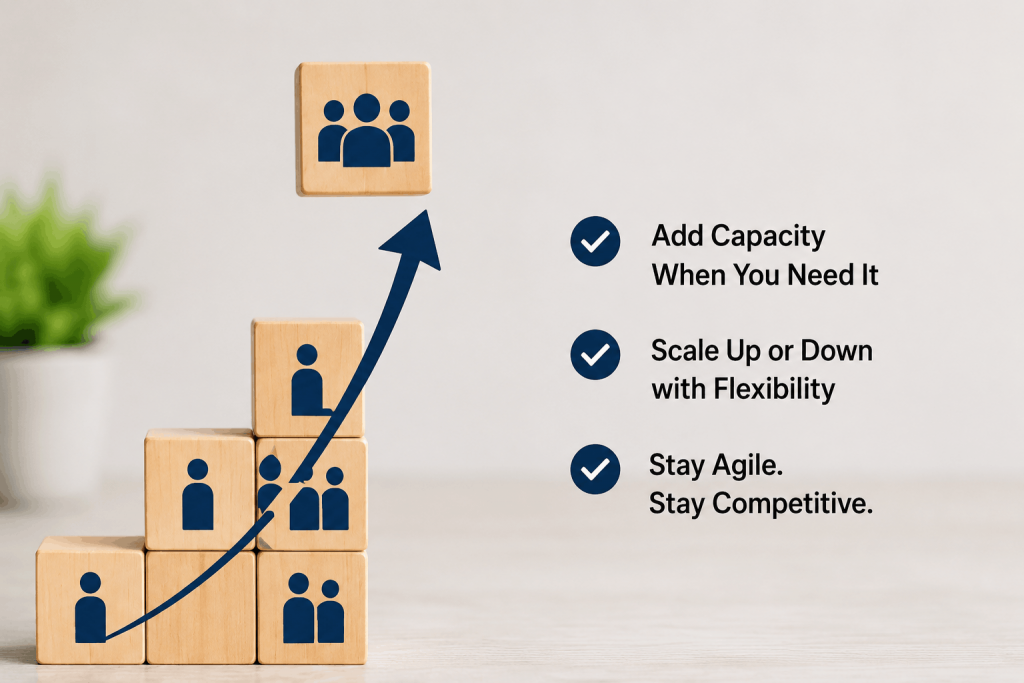
Staff augmentation gives businesses the flexibility to scale their team up or down based on actual demand.
This helps avoid overhiring while still making sure the team has enough support when workload increases. It also gives decision-makers more room to adjust based on project timelines, budgets, and changing business priorities.
For companies in growth stages, this flexibility can be more practical than committing to permanent roles before the need is fully proven.
Some projects require skills that your internal team may not have yet.
For example, your business may need help with AI integration, cloud infrastructure, mobile app development, UX research, automation, cybersecurity, or a specific technology stack. Hiring full-time for each specialist role may not make sense, especially if the need is project-based.
Staff augmentation allows your business to bring in people with specific expertise when that expertise is needed.
This can help your internal team solve technical challenges, improve execution quality, and avoid delays caused by skill gaps. It also gives your business access to a broader talent pool without building every capability in-house from the start.
For digital projects, this is one of the most valuable staff augmentation benefits because technology needs can change quickly.
4. Better Support for Internal Teams
Staff augmentation is not about replacing your existing team. It is about strengthening it.
Many businesses already have capable people in place, but those people may be stretched across too many priorities. When internal teams are overloaded, important work can slow down, quality can suffer, and employees may become frustrated.
Adding external support can help reduce that pressure.
Augmented team members can take on specific tasks, support execution, fill temporary gaps, or help move projects through busy phases. This gives your internal team more space to focus on strategy, decision-making, client relationships, product direction, and other high-value work.
When used well, staff augmentation can improve not only delivery capacity but also team sustainability.
Some businesses hesitate to outsource because they do not want to lose control over the work.
This is where staff augmentation offers a different advantage.
With staff augmentation, your business can keep control of the roadmap, workflows, communication, and quality standards. The external professionals become an extension of your team rather than a separate provider working independently in the background.
This is useful for companies that want to stay closely involved in project decisions but need additional skills or capacity to execute.
For example, your internal team may still own the product vision, technical direction, sprint planning, or approval process. The augmented staff members support the work within that structure.
This balance of support and control is one reason staff augmentation services are often used for software, web, mobile, and digital transformation projects.
When a team does not have enough people, project delivery becomes harder to manage.
Tasks can pile up. Timelines can slip. Senior team members may become bottlenecks. Small issues can turn into larger delays because no one has enough time to address them properly.
Staff augmentation can help improve delivery by giving the team more coverage.
With the right additional support, businesses can assign work more effectively, reduce bottlenecks, and keep projects moving at a healthier pace. This can be especially useful for projects with multiple moving parts, such as website builds, application development, platform migrations, or ongoing technical improvements.
More capacity does not automatically guarantee better delivery, but it gives the team a stronger foundation to meet deadlines and maintain quality.
7. Cost Efficiency Without Long-Term Overcommitment
Hiring full-time employees is an important investment, but it also comes with long-term commitments.
Beyond salary, businesses may need to consider recruitment costs, onboarding, benefits, management time, tools, training, and the risk of hiring for a role that may not be needed permanently.
Staff augmentation can offer a more cost-efficient option for temporary, project-based, or changing needs.
Instead of committing to a permanent hire too early, businesses can bring in support for the period where it creates the most value. This can help control costs while still giving the team the resources needed to complete important work.
For growing businesses, this can be a practical middle ground between doing everything in-house and outsourcing an entire function.
8. Faster Response to Market Opportunities
Growth opportunities do not always arrive on a convenient timeline.
A business may need to launch a new service, improve a digital platform, build a new feature, respond to customer demand, or move quickly before competitors do. If the internal team does not have enough capacity, those opportunities can slow down or pass by.
By adding the right people at the right time, companies can move from planning to execution more quickly. This can support product launches, digital upgrades, automation projects, and other initiatives that affect competitiveness.
For businesses operating in fast-moving industries, the ability to act sooner can be a major advantage.
9. Lower Delivery Risk
Under-resourced teams often carry more risk.
When people are stretched, mistakes are easier to miss. Documentation may be delayed. Testing may be rushed. Communication may become less consistent. Over time, these issues can affect project quality and business outcomes.
Staff augmentation can help reduce this risk by giving the team more realistic capacity.
Additional support can improve coverage across development, testing, design, infrastructure, coordination, or support tasks. It can also help senior team members focus on review, planning, and quality control instead of being pulled into every small execution detail.
The result is not just more output. It is a more stable delivery process.
10. A Practical Path to Long-Term Growth
Staff augmentation can also help businesses make better long-term team decisions.
When a company is growing, it is not always clear which roles should become permanent, which skills are needed only for a season, and which areas need more support over time. Staff augmentation gives businesses a way to test capacity needs before making bigger hiring commitments.
For example, a company may bring in extra development support for a few months and later decide that a permanent role is justified. Another company may use specialized support for a one-time technical project and avoid hiring for a skill it does not need every day.
This makes staff augmentation a useful model for businesses that want to scale thoughtfully, not reactively.
Staff Augmentation vs. Traditional Hiring
Traditional hiring is often the right choice when a business needs a long-term role, strong cultural integration, and ongoing ownership of a function.
Staff augmentation is often better when the business needs flexibility, speed, specialist skills, or temporary capacity.
The two models do not have to compete. In many cases, they work together. A business may use staff augmentation services to support urgent work while continuing to build its internal team over time.
The key is knowing what kind of support the business needs now and what kind of team structure will make sense later.
When Staff Augmentation Works Best
Staff augmentation is most effective when your business has:
✅ Clear project goals
✅ Internal leadership or management capacity
✅ Defined tasks or responsibilities
✅ A need for additional skills or capacity
✅ A desire to keep control over workflows and direction
✅ A workload that may change over time
It may not be the best fit if your business needs a provider to fully own the strategy, manage the entire project independently, or deliver a complete end-to-end solution with minimal internal involvement. In that case, a managed service or project outsourcing model may be more suitable.
But when your business already has direction and simply needs the right people to help execute, staff augmentation can be a strong fit.
The main staff augmentation benefits come down to flexibility, speed, expertise, and control.
For growing businesses, this model can make it easier to access skilled talent, support internal teams, move projects forward, and scale capacity without committing to permanent hiring before the timing is right.
As business needs change, having a flexible way to strengthen your team can make growth more manageable. Staff augmentation gives companies a practical way to respond to demand, reduce delivery pressure, and keep important work moving.
For businesses that need more capacity but still want to stay in control, staff augmentation can be a smart step forward.
FAQs
What are the main staff augmentation benefits?
The main staff augmentation benefits include faster access to skilled talent, flexible team scaling, specialized expertise, better project delivery, cost efficiency, and more control compared to fully outsourced models.
How do staff augmentation services work?
Staff augmentation services work by adding external professionals to your existing team. These professionals support specific roles, projects, or workloads while your business keeps control over direction, priorities, and internal processes.
Is staff augmentation better than hiring full-time employees?
Staff augmentation is not always better than full-time hiring. It depends on the need. Full-time hiring is often best for long-term roles, while staff augmentation is useful for temporary capacity, specialist skills, urgent timelines, or project-based work.
Is staff augmentation only for software development?
No. Staff augmentation is common in software development, but it can also support web and mobile development, UI/UX design, DevOps, QA, AI, data, customer support, operations, and other business functions.
When should a business consider staff augmentation?
A business should consider staff augmentation when it needs more capacity, faster execution, or specialized skills but does not want to commit immediately to a permanent hire or fully outsourced project.
🚀 Ready to strengthen your team without slowing down?
At Lanex, we help growing businesses access skilled professionals through flexible staff augmentation services that support delivery, reduce pressure, and keep projects moving.
Compare staff augmentation cost with in-house hiring and uncover the hidden expenses behind recruitment, benefits, onboarding, turnover, and team growth.
Learn practical steps for IP protection when outsourcing software development, including contracts, access controls, source code ownership, and offboarding.
Avoid common outsourcing mistakes with practical outsourcing tips for choosing the right partner, setting expectations, and managing software projects well.