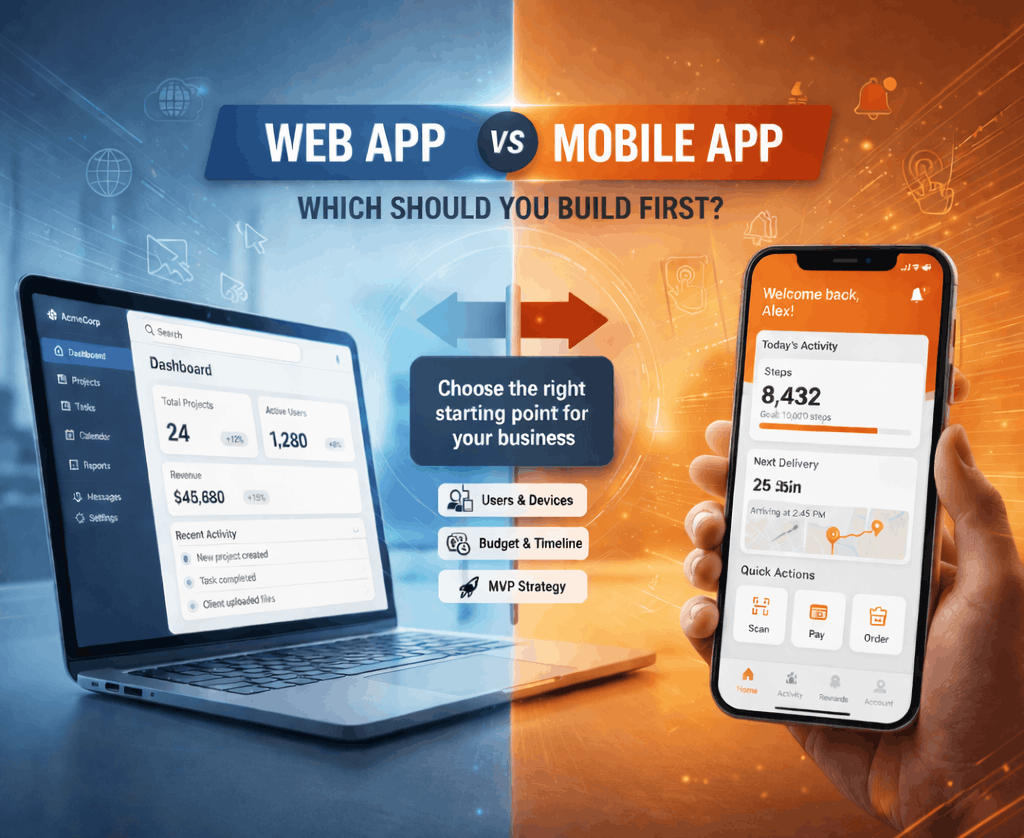
When businesses start planning a new digital product, one of the first big decisions is whether to build a web app or a mobile app first. It sounds like a straightforward choice, but it affects your budget, launch speed, user experience, and even your long-term growth strategy.
The web app vs mobile app decision is not only about design preference. It is about how your users behave, what problem you are solving, and how quickly you need to validate your idea. In many cases, the right answer is not “mobile is better” or “web is better.” It is about choosing the right starting point for your business goals.
This is where a smart web and mobile development strategy matters. Instead of treating both options as interchangeable, it helps to understand how each one supports product launch, user engagement, and future scalability.
Topic Breakdown
What Is a Web App?
A web app is an application users access through a web browser. Unlike a standard informational website, a web app is interactive. Users can log in, manage data, complete tasks, and use features that function much like software.
Examples of web apps include:
- ⦿ project management platforms
- ⦿ CRM systems
- ⦿ booking portals
- ⦿ internal business dashboards
- ⦿ SaaS products
Web apps work across devices as long as there is an internet browser. Users do not need to download anything from an app store, which lowers friction and makes access easier.
What Is a Mobile App?
A mobile app is a software application built for smartphones or tablets. It can be developed as a native app for iOS or Android, or as a cross-platform app that works across both operating systems from a shared codebase.
Mobile apps are often the better choice when the experience depends heavily on:
- ⦿ push notifications
- ⦿ device hardware like camera or GPS
- ⦿ offline usage
- ⦿ frequent daily engagement
- ⦿ mobile-first user behavior
Mobile apps can feel more seamless and personalized, especially when users return to the product often.
Web App vs Mobile App: The Core Difference
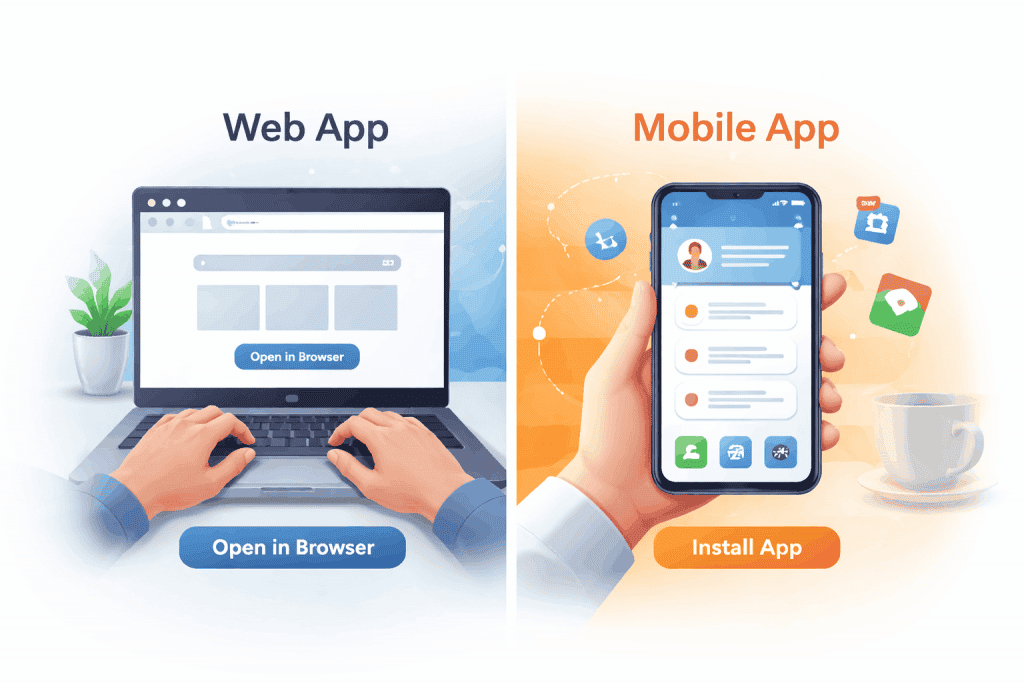
The biggest difference in the web app vs mobile app discussion is how users access and interact with the product.
A web app is easier to reach because it runs in a browser. A mobile app requires installation, but it often delivers a more tailored experience once users are inside.
At a high level:
- ⦿ Web apps prioritize accessibility, faster deployment, and broader compatibility
- ⦿ Mobile apps prioritize performance, retention, and device-native experiences
That is why the best first build depends on your audience and business model.
When It Makes More Sense to Build a Web App First
For many startups and businesses, a web app is the smarter first step.
1. You Want to Launch Faster
Web apps are often quicker to design, develop, test, and update. You can release improvements without waiting for app store approvals, which is especially helpful if you are still refining your product.
If speed to market matters, starting with a web app can help you validate your idea sooner.
2. You Need Easier User Access
A browser-based product is easier for first-time users to try. They can click a link and start using the product without downloading anything.
This is useful for:
- ⦿ B2B platforms
- ⦿ admin portals
- ⦿ client dashboards
- ⦿ marketplaces
- ⦿ early-stage SaaS products
Reducing barriers to entry can improve adoption in the early stages.
3. Your Budget Is Limited
In many cases, a web app can be more cost-effective as a first release. A single browser-based platform may help you avoid the added time, cost, and complexity of launching a mobile app right away, whether that means separate native apps or a cross-platform build.
That does not mean web apps are always cheap, but they can provide a more efficient starting point when resources are tight.
4. Your Product Is Used More on Desktop
If your users are likely to work from laptops or desktop computers, a web app may provide a better experience. This is common in tools that involve dashboards, analytics, large forms, reporting, or back-office workflows.
In the web app vs mobile app comparison, user context matters just as much as user preference.
5. You Are Still Testing Product-Market Fit
If you are in the MVP stage, flexibility matters. Web apps are often easier to iterate, which makes them ideal for testing features, collecting feedback, and adjusting the product direction before investing in a more advanced mobile build.
When It Makes More Sense to Build a Mobile App First
There are also strong cases for launching with a mobile app first.
1. Your Users Are Primarily Mobile-First
If your audience spends most of their time on smartphones, a mobile app may better match their behavior. This is especially true for consumer-facing products where convenience and fast access are essential.
Examples include:
- ⦿ fitness apps
- ⦿ food delivery apps
- ⦿ social platforms
- ⦿ loyalty apps
- ⦿ on-demand services
In these cases, building a mobile experience first may feel more natural to the end user.
2. You Need Push Notifications
Push notifications can play a major role in retention, reminders, and re-engagement. If your business relies on timely alerts, updates, or recurring usage, a mobile app may deliver stronger engagement than a web app.
3. The Product Uses Native Device Features
If your product depends on features like GPS, camera, biometrics, motion sensors, or offline storage, a mobile app can usually create a smoother experience.
While some browser technologies and cross-platform frameworks can access certain device features, native development may still be the better choice when performance, hardware integration, or platform-specific behavior is central to the experience.
4. You Want Higher Daily Engagement
Mobile apps tend to work well when users come back frequently. Once installed, they are easier to reopen, more visible on the user’s device, and often better suited for quick repeated interactions.
That makes mobile a compelling choice for products built around habits or ongoing engagement.
👉 Lanex helps businesses plan, design, and build scalable digital products based on real user needs and business goals. Check out our Web & Mobile App Development services.
Key Questions to Ask Before You Decide
If you are unsure how to approach the web app vs mobile app decision, ask these questions first.
- ⦿ Who are your users?: Think about where and how they will use the product. Are they office-based teams working from laptops, or busy consumers using their phones on the go?
- ⦿ What is the main action users need to complete?: If the product involves complex workflows, data entry, or reporting, a web app may be more practical. If it revolves around quick taps, frequent check-ins, or mobile interactions, a mobile app may be the better fit.
- ⦿ How important is speed to market?: If you need to launch quickly and start learning from real users, a web app often gives you a more flexible starting point.
- ⦿ What is your budget for version one?: A lean first release may benefit from focusing on one platform first, or choosing a cross-platform approach if mobile access is essential from day one. A strong web and mobile development roadmap can help you avoid overbuilding too early.
- ⦿ What does future growth look like?: Some businesses start with a web app, then expand into mobile once demand is proven. Others begin with mobile and later add a web portal for admin or support functions. Your first build should support your long-term product vision, not compete with it.
Why Many Businesses Start With a Web App
In practice, many companies choose to launch a web app first because it is often the most practical way to test, refine, and scale a digital product.
A web app can help you:
- ⦿ reach users faster
- ⦿ gather feedback earlier
- ⦿ manage updates more easily
- ⦿ reduce initial development complexity
- ⦿ create a foundation for future expansion
Then, once the product gains traction, mobile apps can be introduced as part of a wider growth strategy.
This staged approach is common in web and mobile development because it balances speed, cost, and user needs.
Why Some Businesses Need Both
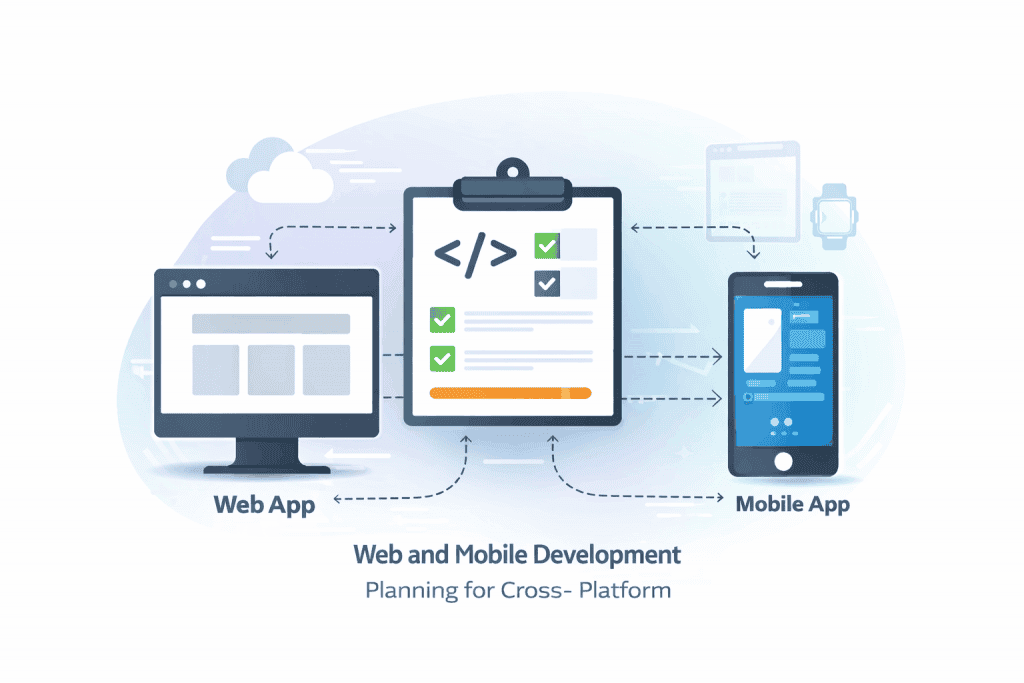
Sometimes the answer is not one or the other. Some products are strongest when web and mobile work together.
For example:
- ⦿ a service marketplace may need a web-based admin panel and a customer mobile app
- ⦿ a healthcare platform may need desktop access for providers and mobile access for patients
- ⦿ a logistics solution may need a browser dashboard for management and a mobile interface for field teams
In these cases, the real question is not just web app vs mobile app. It is which one should come first, and how both experiences will support the overall product ecosystem.
Common Mistakes Businesses Make
- ⦿ Building both too early: Trying to launch web and mobile at the same time can stretch budgets and slow down delivery. For many businesses, it is better to focus on one high-impact version first.
- ⦿ Choosing based on trend, not user need: Some teams default to mobile because apps feel more modern. Others choose web because it seems simpler. Neither is the right reason. The decision should come from user behavior and business goals.
- ⦿ Ignoring long-term scalability: Your first version should not block future growth. Even if you begin with one platform, your architecture and planning should support expansion later.
- ⦿ Overcomplicating the MVP: A first release should validate your idea, not attempt to solve every possible need. Clear priorities usually lead to better launches.
A Practical Way to Decide
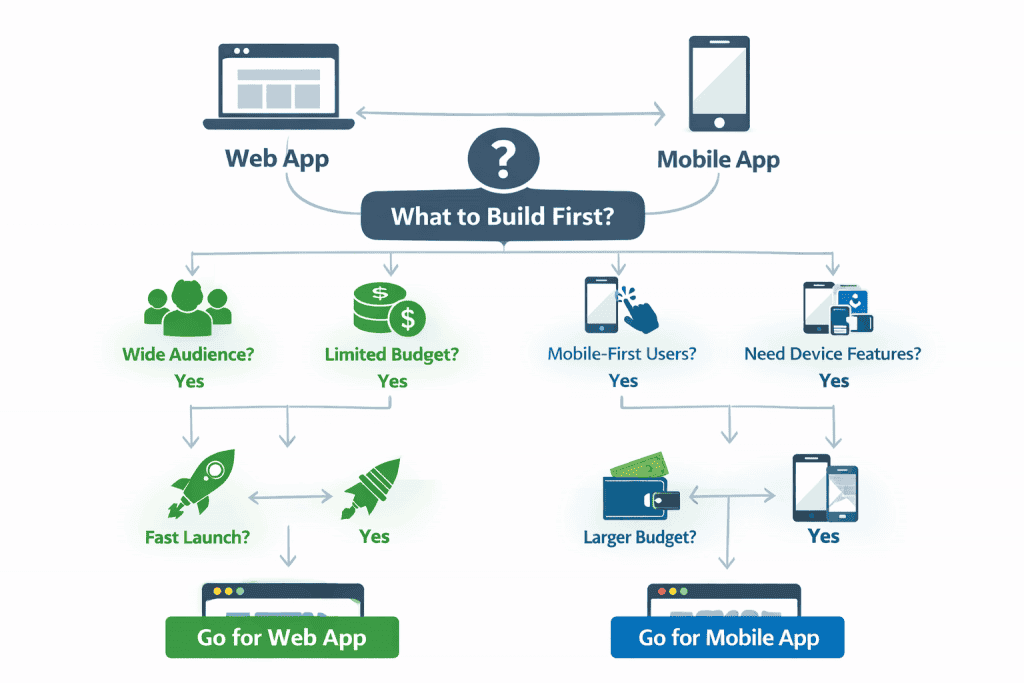
A simple way to make the decision is to score your product in three areas:
Choose web app first if:
- ⦿ users are likely to start on desktop or browser
- ⦿ speed to launch matters
- ⦿ your MVP needs rapid updates
- ⦿ you want easier onboarding without app downloads
- ⦿ your budget is tighter for phase one
Choose mobile app first if:
- ⦿ users mainly interact on smartphones
- ⦿ push notifications are important
- ⦿ the product relies on device-native features
- ⦿ daily engagement is a major goal
- ⦿ the experience is clearly mobile-first
This type of evaluation gives structure to the web app vs mobile app decision rather than leaving it to assumptions.
How the Right Development Partner Helps
Choosing the right first platform is easier when your development team looks beyond code and focuses on business outcomes.
A strong partner in web and mobile development should help you:
- ⦿ evaluate product goals
- ⦿ identify user behavior patterns
- ⦿ define the best MVP scope
- ⦿ prioritize features for launch
- ⦿ plan for future scaling across platforms, including whether native or cross-platform development is the better fit for mobile expansion
This is especially important for startups and growing businesses that need to balance cost, speed, and product quality without wasting resources.
👉 RELATED READING: Outsourcing Software Development in 2026: What US Businesses Need to Know.
Final Thoughts
The web app vs mobile app decision is one of the most important product choices a business can make early on. The right answer depends on your users, your timeline, your budget, and the type of experience you want to deliver.
If your priority is speed, accessibility, and early validation, a web app is often the best place to start. If your product depends on mobile behavior, notifications, or native device features, a mobile app may be the better first move.
The key is not choosing the more popular option. It is choosing the smarter launch path for your business.
When approached strategically, web and mobile development becomes less about picking sides and more about building the right product in the right order.
FAQs
What is the main difference between a web app and a mobile app?
A web app runs in a browser and does not need to be installed, while a mobile app is downloaded to a smartphone or tablet and is built for mobile operating systems.
Is a web app cheaper to build than a mobile app?
In many cases, a web app can be more cost-effective for an initial launch, especially if it helps avoid the added cost and complexity of mobile app development right away, whether through separate native apps or a cross-platform build.
Which is better for an MVP, a web app or a mobile app?
For many businesses, a web app is better for an MVP because it can be faster to launch and easier to update while testing the market.
When should I build a mobile app first?
A mobile app makes more sense when your users are primarily on smartphones, the product needs push notifications, or the experience relies on device-native features.
Can a business have both a web app and a mobile app?
Yes. Many businesses eventually build both. The key is deciding which one delivers the most value first and fits the product roadmap.
Is a website the same as a web app?
No. A website is often informational, while a web app is interactive and allows users to complete actions such as logging in, managing data, or performing tasks.
How do I choose between a web app and a mobile app?
Start by evaluating user behavior, product goals, feature requirements, budget, and launch timeline. The best choice is the one that supports real usage and business needs.
Does a mobile app always provide a better user experience?
Not always. Mobile apps can offer a more tailored experience, but web apps may be more convenient depending on the product and how users access it.
What is cross-platform mobile development?
Cross-platform mobile development is the process of building one app that can run on both iOS and Android using a shared codebase. It can help businesses launch faster and more efficiently, although native development may still be better for certain performance-heavy or device-specific use cases.
🚀 Not sure whether to start with a web app or a mobile app?
If you are evaluating your next product move, our team can help you choose the right path forward.