
Outsourcing software development has evolved far beyond cost savings. In 2026, US businesses are outsourcing to move faster, access scarce talent, and stay competitive in an AI-driven digital economy.
From startups to mid-market firms and enterprises, outsourcing is now a strategic lever, not just an operational shortcut. But the rules have changed. What worked in 2024 or 2025 may no longer be enough. For many companies, software development outsourcing is now a strategic decision tied directly to speed, innovation, and long-term competitiveness.
This guide breaks down what US businesses need to know to outsource software development successfully in 2026.
Topic Breakdown
Why Outsourcing Software Development Still Makes Sense in 2026
Despite economic uncertainty and rising expectations around security and quality, outsourcing remains a powerful advantage for US companies.
Here’s why:
- ➡️ US tech talent costs continue to rise
- Senior engineers, AI specialists, and DevOps professionals command premium salaries, making full in-house teams expensive and slow to scale.
- ➡️ Speed to market matters more than ever
- Businesses can’t afford long hiring cycles when competitors are shipping faster using global teams.
- ➡️ Specialized skills are harder to hire locally
- AI/ML, cloud-native architecture, cybersecurity, and DevOps expertise are often more accessible through global talent markets.
- ➡️ Flexibility without long-term risk
- Outsourcing allows teams to scale up or down without long-term employment commitments.
In 2026, outsourcing is less about replacing internal teams and more about extending them intelligently.
Key Outsourcing Models US Businesses Use Today
Not all outsourcing is the same. Choosing the right model matters just as much as choosing the right partner. US companies that outsource software development often choose between offshore, nearshore, or dedicated team models depending on cost, collaboration needs, and product maturity.
Offshore Software Development
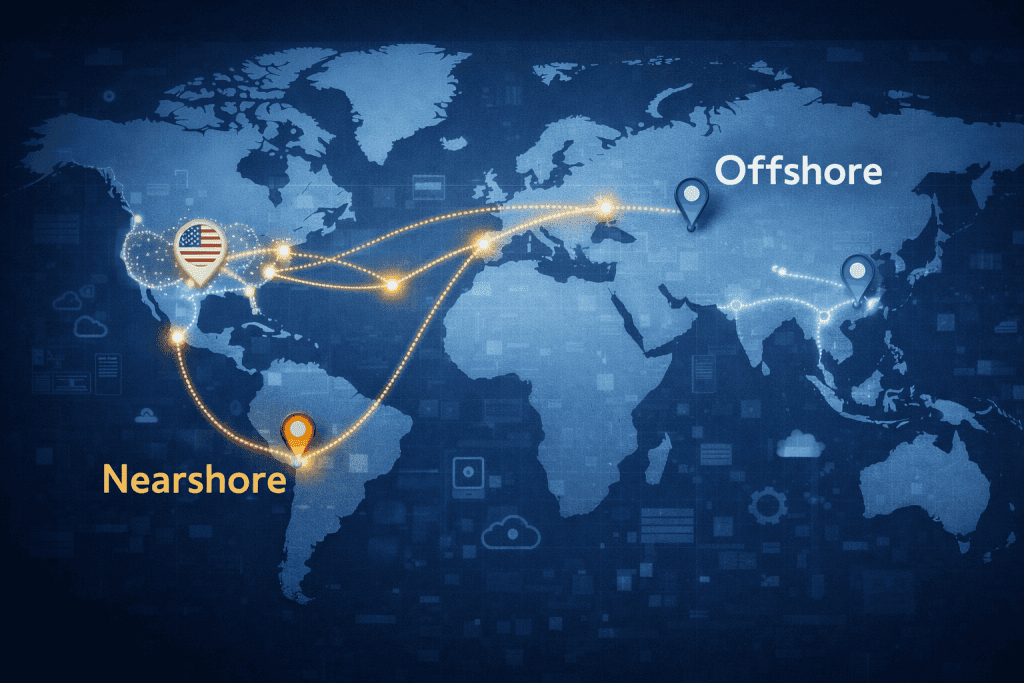
Offshore development involves working with teams located in regions like Southeast Asia, Eastern Europe, or Latin America. Offshore software development continues to attract US businesses looking to scale engineering teams quickly while managing overall development costs.
Best for:
- ✔️ Cost efficiency
- ✔️ Large, scalable teams
- ✔️ Long-term development roadmaps
Considerations:
- ✔️ Time zone differences
- ✔️ Communication processes
- ✔️ Strong project management is essential
Nearshore Software Development
Nearshore outsourcing typically refers to partners in similar or overlapping time zones, such as Latin America for US companies. When comparing nearshore vs offshore development, US businesses often weigh real-time collaboration against cost efficiency.
Best for:
- ✔️ Real-time collaboration
- ✔️ Cultural and language alignment
- ✔️ Faster feedback cycles
Considerations:
- ✔️ Higher costs than offshore
- ✔️ Smaller talent pools in some regions
Dedicated Development Teams
A dedicated team acts as an extension of your internal engineering department, often working exclusively on your product.
Best for:
- ✔️ Growing SaaS platforms
- ✔️ Long-term product development
- ✔️ Businesses that want consistency and ownership
Considerations:
- ✔️ Requires clearer leadership and roadmap planning
- ✔️ Works best with strong internal product direction

What’s Changed Since 2024–2025
Outsourcing in 2026 looks very different from just a few years ago.
Key shifts include:
- ➡️ AI-assisted development is now standard
- Teams are expected to use AI tools to improve speed, testing, and documentation, not as a novelty, but as a baseline.
- ➡️ Higher expectations for delivery quality
- Clean code, security-first practices, and scalable architecture are no longer “nice to have.”
- ➡️ Security and compliance take center stage
- US businesses now expect partners to support SOC 2, GDPR, HIPAA (where relevant), and strong IP protection by default.
- ➡️ Outcome-based pricing is more common
- More companies are moving away from purely hourly billing toward milestone-based or hybrid pricing models.
These outsourcing software development trends reflect a shift toward higher accountability, stronger security standards, and outcome-driven partnerships.
Cost Expectations for Outsourcing in 2026
While exact costs vary by region and skill set, most US businesses now focus on total cost of ownership (TCO) rather than hourly rates alone.
Key cost factors include:
- ✅ Engineering seniority and specialization
- ✅ AI and cloud expertise
- ✅ Project complexity and scalability requirements
- ✅ Communication, documentation, and QA standards
In 2026, the cheapest option often becomes the most expensive once rework, delays, and security issues are factored in. Smart companies prioritize value, reliability, and long-term scalability over headline pricing.
Risks US Businesses Must Actively Manage
Outsourcing delivers results only when risks are addressed proactively.
Common risks include:
- ➡️ Intellectual property protection
- Clear contracts, ownership clauses, and secure development practices are critical.
- ➡️ Compliance and regulatory exposure
- Especially important for healthcare, fintech, and data-driven platforms.
- ➡️ Vendor lock-in
- Over-reliance on undocumented systems or proprietary frameworks can limit future flexibility.
- ➡️ Communication breakdowns
- Poor documentation and unclear ownership can derail even technically strong teams.
The best outsourcing partners address these risks upfront, not after problems arise.

How to Choose the Right Outsourcing Partner in 2026
In 2026, US businesses should evaluate partners beyond portfolios and hourly rates.
Look for:
- ✅ Proven experience with modern tech stacks
- ✅ Mature development processes and reporting
- ✅ Transparent communication and documentation
- ✅ Strong security and compliance awareness
- ✅ Cultural alignment and long-term scalability
A strong outsourcing partner doesn’t just “build what you ask”; they help you make better technical and strategic decisions.
When Outsourcing Is NOT the Right Move
Outsourcing isn’t always the answer.
It may not be ideal if:
- ✅ Your product vision is unclear or constantly changing
- ✅ You lack internal technical leadership
- ✅ You’re building a highly experimental MVP with undefined scope
In these cases, internal prototyping or short-term consulting may be a better first step.
Outsourcing vs Staff Augmentation: A Quick Comparison
- ➡️ Outsourcing
- Best for end-to-end delivery, speed, and scalability with less internal overhead.
- ➡️ Staff Augmentation
- Ideal when you need specific skills to strengthen an existing in-house team.
Many US businesses use both models together depending on product stage and growth goals.
Making Outsourcing a Competitive Advantage in 2026
Outsourcing software development in 2026 is no longer about doing more with less; it’s about doing better, faster, and smarter.
US businesses that treat outsourcing as a true partnership—focused on outcomes, quality, and long-term value—will be best positioned to innovate, scale, and compete in the years ahead.
FAQs
Is outsourcing software development safe for US businesses in 2026?
Yes, when done correctly. In 2026, reputable outsourcing partners follow strict security practices, including IP protection clauses, secure development environments, and compliance with standards like SOC 2 and GDPR. US businesses should prioritize vendors with proven security processes, not just lower costs.
How much does it cost to outsource software development in 2026?
The cost of outsourcing software development varies based on team location, technical complexity, and required expertise. Rather than focusing only on hourly rates, most US businesses now evaluate total cost of ownership, factoring in quality, delivery speed, and long-term scalability.
What is the difference between offshore and nearshore software development?
Offshore software development typically offers greater cost efficiency and access to larger talent pools, while nearshore development provides closer time zone alignment and easier real-time collaboration. When comparing nearshore vs offshore development, US companies should balance communication needs with budget and scale requirements.
Can outsourced teams support AI and advanced software development?
Yes. In fact, many US businesses outsource specifically to access AI, machine learning, cloud, and DevOps expertise that is difficult to hire locally. In 2026, AI-assisted development workflows are standard among experienced outsourcing teams.
How do US companies protect intellectual property when outsourcing?
IP protection starts with clear contracts that define ownership, confidentiality, and usage rights. Leading outsourcing providers also implement secure repositories, access controls, and documented handover processes to ensure US businesses retain full ownership of their software.
Is outsourcing or staff augmentation better for growing companies?
Both models serve different needs. Outsourcing is ideal for end-to-end delivery and faster execution, while staff augmentation works best when supplementing an existing internal team. Many companies partner with providers like Lanex Corporation to combine both approaches based on project stage and growth goals.
🚀 Ready to Outsource Software Development in 2026?
At Lanex, we help US businesses design, build, and scale software through carefully structured outsourcing and dedicated development teams. Whether you’re modernizing an existing platform or building something new, our approach prioritizes quality, security, and measurable outcomes.