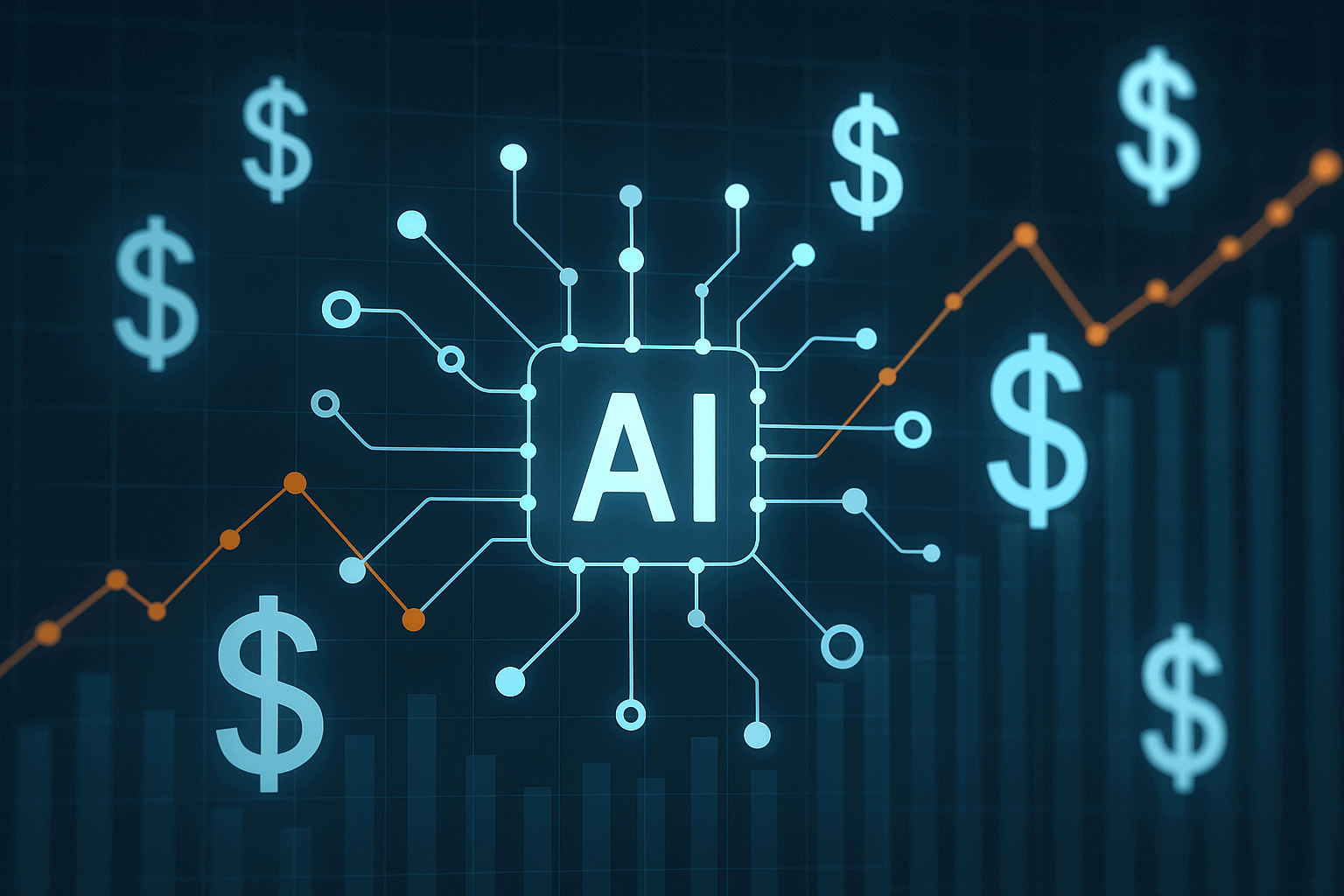
Artificial intelligence has shifted from a cutting-edge differentiator to a practical business necessity. Whether you’re building smarter customer experiences, automating internal workflows, or launching an AI-powered product, one question always comes up first:
How much will AI development actually cost in 2026?
The answer is… it depends. But with clearer benchmarks, businesses can budget confidently and avoid unwelcome surprises during development.
Below, we break down actual AI development cost ranges, the factors that impact pricing, and what US companies should expect when building AI in 2026.
Topic Breakdown
Why AI Development Costs Are Rising in 2026
Thanks to advancements in large language models (LLMs), model fine-tuning, vector search, and GPU availability, AI development has become more accessible, but not necessarily cheaper.
Here’s why costs are trending upward:
- ➡️ Higher infrastructure demand for GPUs, cloud compute, and storage
- ➡️ More specialised expertise needed for applied AI engineering
- ➡️ Growing need for data preparation and governance
- ➡️ Security and compliance requirements driving additional layers of work
- ➡️ Customization expectations as businesses move beyond off-the-shelf tools
Despite the rising investment, AI continues to deliver significant ROI, often within months.
How Much Will AI Development Cost in 2026?
The cost of AI development varies by complexity, level of customization, and the size of the project.
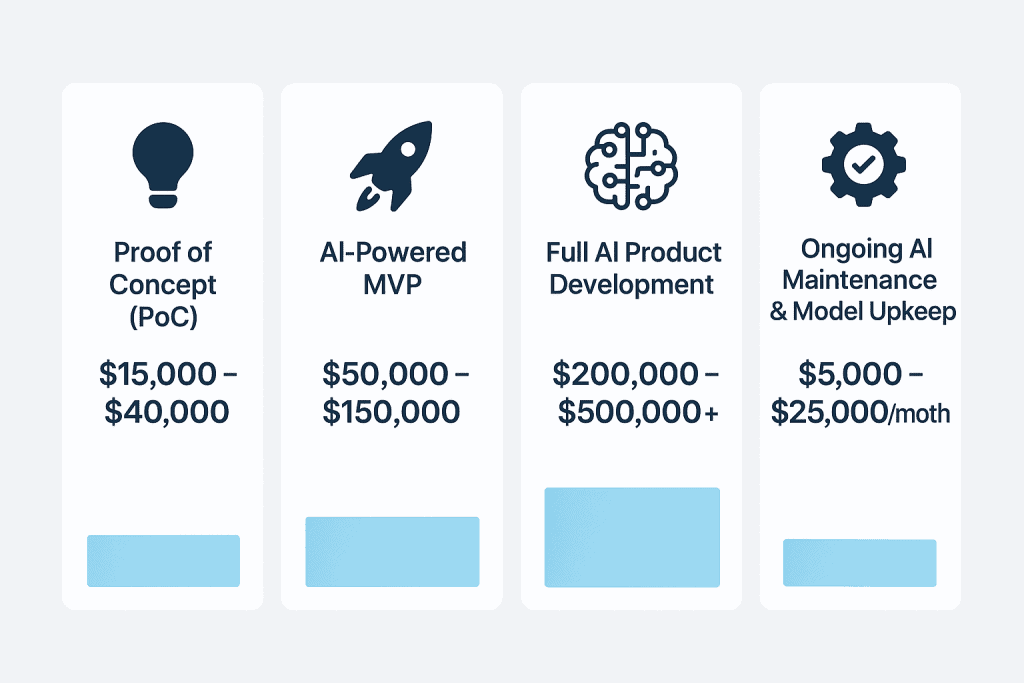
Here are the expected cost ranges for 2026:
1. Proof of Concept (PoC): Small experiments to validate feasibility
Cost Range: $15,000–$40,000
Timeline: 3–6 weeks
Best suited for:
- ✔️ Testing a single AI capability
- ✔️ Internal automation prototypes
- ✔️ Small AI assistants or chatbot demos
2. AI-Powered MVP (Minimum Viable Product): Functional but lean product for early users
Cost Range: $50,000–$150,000
Timeline: 8–16 weeks
Includes:
- ✔️ Basic model integration (LLMs, vision, or analytics)
- ✔️ Early UI/UX
- ✔️ Limited data connectors
- ✔️ Initial cloud infrastructure setup
3. Full AI Product Development: Scalable, production-ready AI solution
Cost Range: $200,000–$500,000+
Timeline: 4–8+ months
Often includes:
- ✔️ Custom model fine-tuning
- ✔️ Multi-role apps (web + mobile)
- ✔️ Advanced data pipelines
- ✔️ Security, governance, and compliance
- ✔️ Enterprise-level cloud infrastructure
4. Ongoing AI Maintenance & Model Upkeep
Cost Range: $5,000–$25,000/month
Covers:
- ✔️ Retraining models
- ✔️ Monitoring accuracy
- ✔️ Updating prompts, workflows, and connectors
- ✔️ Infrastructure scaling
- ✔️ New feature expansions
Key Factors That Influence the Cost of AI Development
AI development costs vary widely, and several core factors drive those differences. Understanding these elements helps US businesses budget accurately and avoid unexpected expenses as they plan AI initiatives in 2026.
1. The Type of AI You’re Building: Some AI systems are inherently more complex than others.
Common complexity tiers:
- 🟢 Low complexity: Chatbots, rule-based automation → lower cost
- 🟢 Medium complexity: Recommendation systems, predictive analytics
- 🟢 High complexity: Vision models, voice analysis, multi-agent systems
- 🟢 Very high complexity: Custom LLMs, real-time video AI
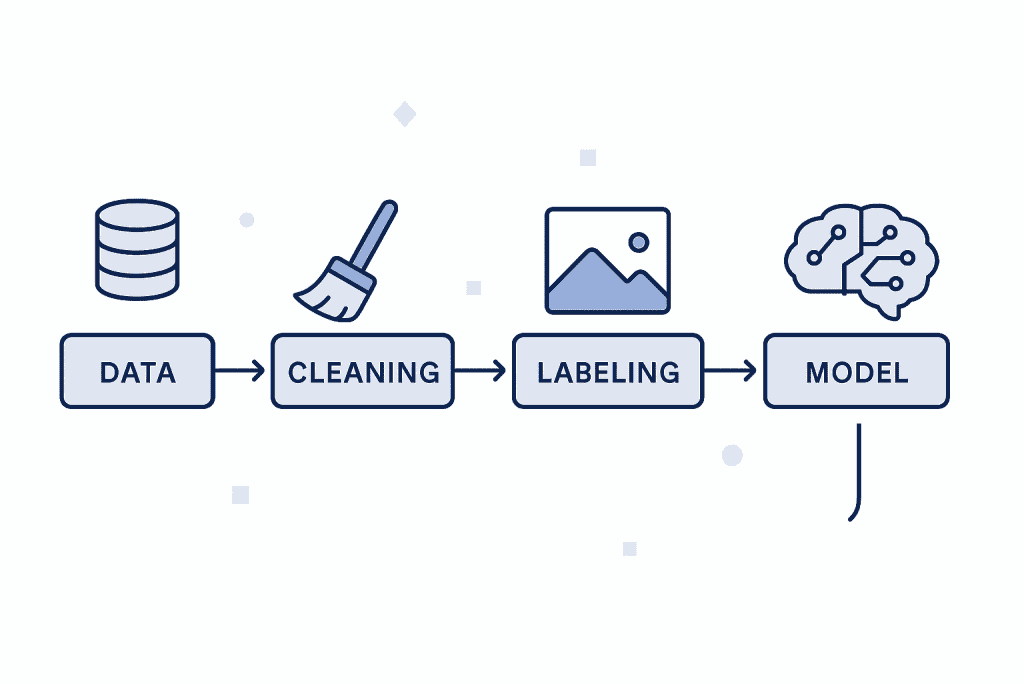
2. Data: The Hidden Cost Driver: Data preparation often consumes 40–60% of total AI development costs.
This includes:
- 🟢 Cleaning and labelling
- 🟢 Governance
- 🟢 Structuring data pipelines
- 🟢 Integrating external datasets
3. Custom vs. Off-the-Shelf Models
Using existing models (like OpenAI, Anthropic, or Google) lowers development costs.
Building or fine-tuning your own model significantly increases them.
4. Team Structure: US-Based, Outsourced, or Staff Augmentation
This is where many businesses overspend. Here’s the difference:
- 🟢 US-based engineers: Highest cost but fastest alignment
- 🟢 Outsourcing overseas: Cost-effective but requires strong partnership
- 🟢 Staff augmentation: Best of both worlds — flexible, scalable, and affordable
5. Required Integrations
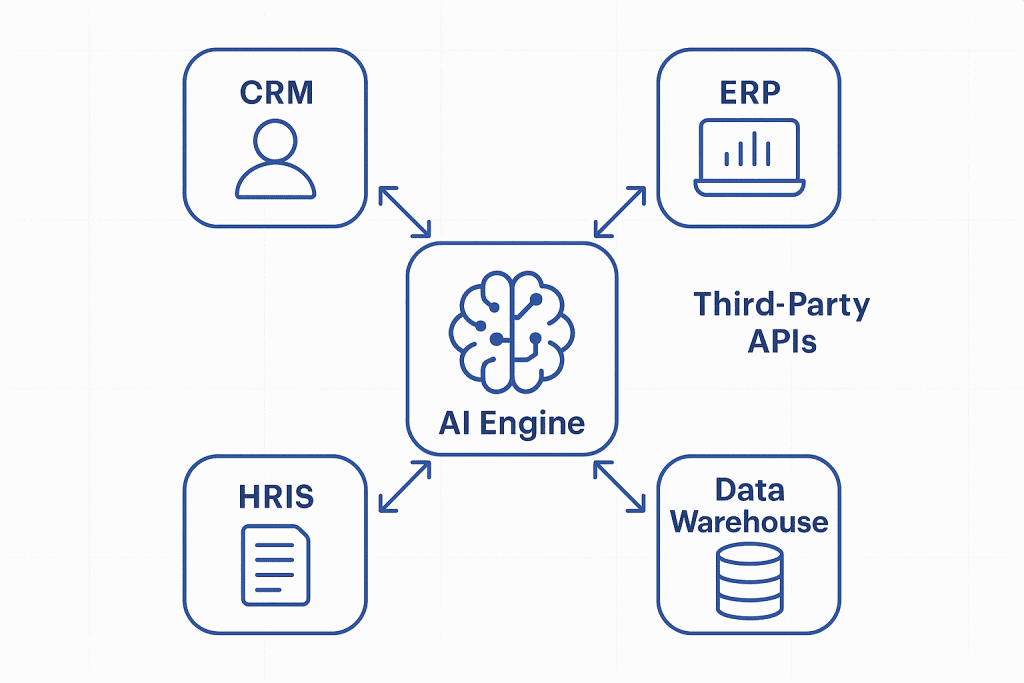
Connecting your AI system to CRMs, ERPs, HRIS tools, communication platforms, data warehouses, third-party APIs, or IoT devices can significantly influence both timeline and cost.
Each integration requires mapping data flows, handling authentication, and ensuring the AI outputs sync reliably back into the business’s existing tools. More complex ecosystems, especially those with legacy systems or multiple data sources, often require additional engineering effort to build stable, secure, and scalable integrations.
6. Security & Compliance Requirements
US companies, especially in finance, healthcare, and logistics, need to consider:
- 🟢 SOC 2 (Service Organization Control 2)
- 🟢 HIPAA (Health Insurance Portability and Accountability Act)
- 🟢 GDPR (EU) & CCPA/CPRA (California Consumer Privacy Act & Rights Act)
- 🟢 Zero-data retention models
Expected cost increases depending on compliance needs:
- ➡️ Basic business AI: Minimal compliance → small impact
- ➡️ Financial, HR, or logistics AI: +10–20%
- ➡️ Healthcare HIPAA AI: +20–35%
- ➡️ Enterprise-grade SOC 2–level infrastructure: +15–30%
- ➡️ Zero-retention AI models: More costly API selections + more infra → +10–20%
How to Budget for AI Development in 2026
Use this simple formula:
AI Total Cost = (Build Cost) + (Infrastructure) + (Ongoing Model Maintenance)
Recommended budgeting guidelines for US businesses:
- ✅ Allocate 15–25% for unforeseen model adjustments
- ✅ Budget monthly cloud GPU costs upfront
- ✅ Plan for human-in-the-loop training in the first 3–6 months
- ✅ Consider staff augmentation to reduce US hiring overhead
How US Businesses Can Reduce AI Development Costs
- 1. Start with a Proof of Concept: Validate first, scale later.
- 2. Use open-source and pre-trained models: Avoid building your own unless absolutely required.
- 3. Outsource or augment your team: Reduces hiring and onboarding costs.
- 4. Build modular AI systems: This makes future upgrades cheaper.
- 5. Partner with an experienced AI development team: Prevents rework, scope bloat, and infrastructure waste.
Who Should Build Your AI Solution?
If you’re evaluating partners, choose a team with:
- ✅ Proven AI/ML engineering experience
- ✅ Strong US market alignment
- ✅ Expertise in web & mobile app development
- ✅ Ability to handle ongoing model maintenance
- ✅ Transparent pricing and communication
This ensures you’re investing in a solution that actually delivers ROI, and not a science project.
FAQs
What is the average AI development cost in the US in 2026?
Most AI projects will fall between $50,000 and $250,000, depending on complexity and scale.
Why are AI projects more expensive now than in previous years?
More advanced frameworks, GPU requirements, and security standards have increased overall development effort.
Is it cheaper to outsource AI development?
Yes. Outsourcing or using staff augmentation can reduce engineering costs by 40–60%.
Do I need my own data to build an AI solution?
Not always. Many solutions run on pre-trained models, but the best results come from combining them with your proprietary data.
How long does it take to build an AI product?
Anywhere from 6 weeks to 8 months, depending on complexity.
Are there hidden costs in AI development?
Yes—data cleaning, cloud compute, model retraining, and security compliance often surprise businesses.
Which industries will benefit most from AI in 2026?
Healthcare, logistics, financial services, e-commerce, HR tech, and professional services.
Do I need ongoing maintenance after launching an AI product?
Absolutely. Models degrade over time and require monitoring, retraining, and updates.
What’s the cheapest way to start AI development?
Launch a small Proof of Concept before committing to a full system.
How do I make sure my AI project stays within budget?
Define scope early, avoid unnecessary custom model training, and work with an experienced development partner.
🚀 Ready to bring AI into your business without overspending?
Lanex helps US companies build scalable, cost-efficient AI solutions, whether you’re launching a PoC or a full enterprise product.