
Scalable web applications are not built by accident. For high-growth companies, scalability has to be planned from the beginning, not patched in later when traffic increases, teams expand, or customer expectations become harder to meet.
A web application may work well for the first few hundred users. It may even perform smoothly during early product launches or internal rollouts. But once a business starts growing quickly, the same system can begin to show pressure. Pages load slower. Features become harder to update. Integrations break more often. Security reviews become more complex. What once felt like a flexible product can suddenly feel like a bottleneck.
That is why high-growth companies need more than a working web app. They need a system that can support more users, more data, more transactions, and more business complexity without becoming unstable or expensive to maintain.
This is where thoughtful enterprise web development becomes important. Scalability is not just about handling traffic. It is about building a web application that can grow with the business.
Topic Breakdown
What Makes a Web Application Scalable?
A scalable web application can handle growth without requiring constant rebuilds. As user demand increases, the system should be able to support higher traffic, larger databases, more integrations, and expanding feature requirements.
In practical terms, scalability means the application can:
- ⦿ handle more users without slowing down
- ⦿ support new features without breaking existing ones
- ⦿ process larger volumes of data efficiently
- ⦿ connect with third-party tools and internal systems
- ⦿ stay secure as the business grows
- ⦿ remain maintainable for development teams
For high-growth companies, scalability is also about timing. The goal is not always to build the biggest system on day one. Instead, the goal is to build with enough structure so the application can evolve when the business is ready.
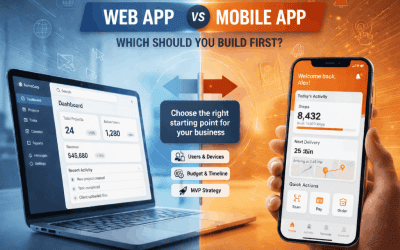
👉 RELATED READING: Web App vs Mobile App: Which Should You Build First?
Start With the Right Architecture
The architecture of a web application affects almost everything that comes after it. It influences performance, development speed, security, integrations, hosting costs, and long-term flexibility.
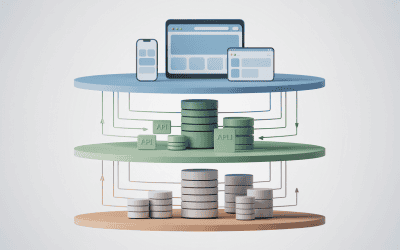
A scalable architecture should be designed around the company’s current needs and future growth plans. This may include cloud infrastructure, modular codebases, API-first development, load balancing, caching, and database strategies that can support increasing demand.
The key is to avoid building a system that only solves today’s problem. For example, a simple web app may be enough for an early-stage company, but if the business expects rapid customer growth, multiple user roles, payment processing, analytics, or workflow automation, the architecture should account for those possibilities early.
A strong architecture gives the development team room to improve the product without constantly undoing previous work.
Design for Performance From the Beginning
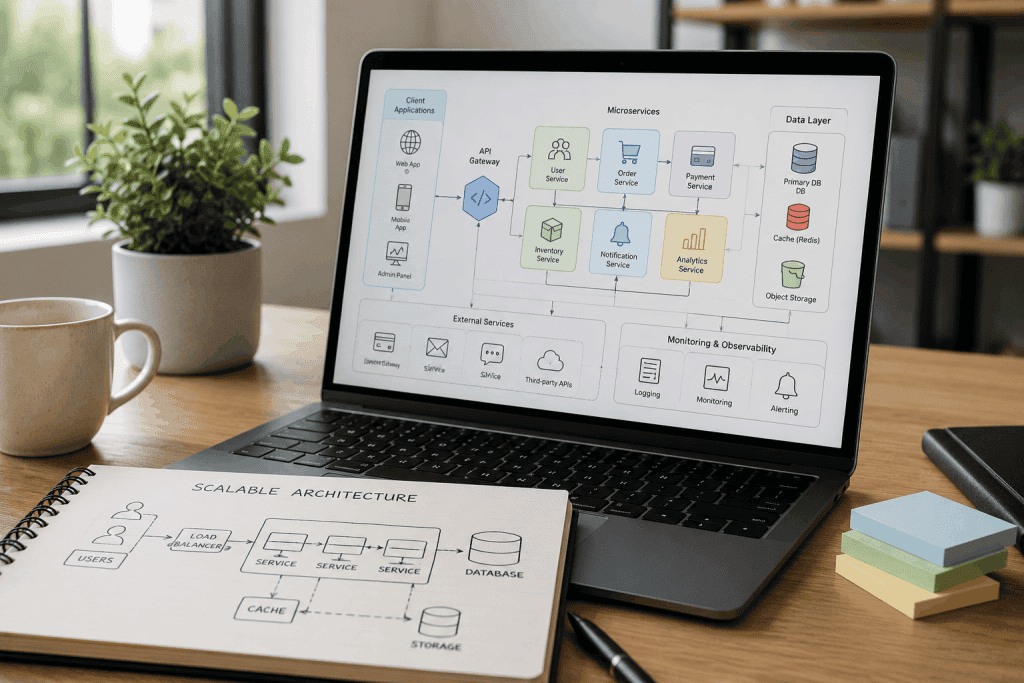
Performance is one of the most visible signs of scalability. Users may not know how the application is built, but they notice when pages are slow, dashboards freeze, or transactions take too long to process.
For high-growth companies, performance should be treated as a core requirement, not a final cleanup task. This includes optimizing front-end assets, reducing unnecessary server requests, using efficient database queries, and applying caching where appropriate.
Performance also affects user trust. If customers rely on the application to complete important tasks, delays can create frustration. In B2B environments, poor performance can also affect adoption, renewals, and internal team productivity.
A scalable web application should feel reliable even as usage increases.
Build With Security in Mind
As web applications grow, they often handle more sensitive data. This can include customer records, payment information, business documents, internal workflows, or user behavior data.
Security should be built into the development process from the start. This means secure authentication, access control, encryption, input validation, secure APIs, and regular vulnerability testing. It also means making sure security practices are not treated as one-time checklist items.
For enterprise web development, security becomes even more important because larger organizations often have stricter compliance, procurement, and vendor review requirements. A scalable application should be ready for those expectations before they become urgent.

Choose the Right Technology Stack
The technology stack should match the application’s goals, not just the latest trend. A stack that works for a small internal tool may not be the best choice for a customer-facing platform with thousands of users.
When choosing the right stack, high-growth companies should consider:
- ⦿ development speed
- ⦿ long-term maintainability
- ⦿ available developer talent
- ⦿ hosting and infrastructure costs
- ⦿ security requirements
- ⦿ integration needs
- ⦿ performance expectations
- ⦿ future product roadmap
The best stack is not always the most complex one. In many cases, the right choice is the one that supports business growth while staying manageable for the team that will maintain it.
🎯 Lanex helps businesses design and develop scalable web applications that support long-term growth. Whether you need a full development team, specialized technical support, or a stronger foundation for your next digital product, we can help you build with confidence. Check out our Web App Development services.
Use APIs to Keep the System Flexible
APIs help scalable web applications stay flexible. Instead of building one rigid system where every feature is tightly connected, APIs allow different parts of the application to communicate in a cleaner and more structured way.
This is especially useful for high-growth companies that need to integrate with tools such as CRMs, payment gateways, analytics platforms, HR systems, inventory systems, or AI-powered services.
An API-first approach can also make it easier to support future mobile apps, partner portals, internal dashboards, or automation workflows. As the company grows, the application does not have to be rebuilt from scratch every time a new business need appears.
Plan for Database Growth
Many web applications start with a simple database structure. That may work early on, but as the company grows, database performance can become one of the biggest challenges.
A scalable database strategy should account for how data will be stored, queried, backed up, secured, and archived. Poor database design can lead to slow reports, delayed transactions, duplicated records, and expensive performance fixes later.
High-growth companies should think carefully about:
- ⦿ how much data the application will collect
- ⦿ how often that data will be accessed
- ⦿ which records need real-time processing
- ⦿ what reporting and analytics will be required
- ⦿ how data will be secured and backed up
Database planning may not feel urgent during the early stages of a project, but it can make a major difference once the application starts handling real business volume.
Make the Application Easy to Maintain
Scalability is not only about infrastructure. It is also about how easily the development team can maintain and improve the application.
A web application becomes harder to scale when the codebase is messy, documentation is missing, testing is inconsistent, or only one developer understands how everything works. This creates risk for the business, especially when the application becomes central to daily operations.
Maintainable applications usually have clean code structures, proper documentation, version control, automated testing, and clear deployment processes. These practices make it easier to add new features, fix bugs, onboard new developers, and reduce downtime.
For high-growth companies, maintainability protects momentum.
Prepare for Cloud Scalability
Cloud platforms give companies more flexibility to scale infrastructure based on demand. Instead of relying on fixed server capacity, businesses can use cloud resources that adjust as traffic and workloads change.
However, cloud scalability still needs planning. Simply moving an application to the cloud does not automatically make it scalable. The application needs to be designed to use cloud resources properly.
This may include auto-scaling, distributed storage, content delivery networks, monitoring, backups, disaster recovery, and cost management. Without the right setup, cloud systems can become either underpowered or unnecessarily expensive.
The goal is to create infrastructure that supports growth without wasting resources.
Monitor, Test, and Improve Continuously
A scalable web application should be monitored after launch. Real user behavior, traffic patterns, server performance, error logs, and database activity can reveal issues that may not appear during development.
Monitoring helps teams detect problems early before they affect customers. Load testing and performance testing can also show how the application behaves under pressure.
For high-growth companies, this matters because traffic spikes are not always predictable. A marketing campaign, product launch, investor announcement, or new enterprise client can suddenly increase demand.
Continuous improvement keeps the application ready for the next stage of growth.
Build the Right Development Team

Scalable web applications require the right technical expertise. This may include software architects, full-stack developers, backend developers, DevOps engineers, QA testers, UI/UX designers, and project managers.
For many high-growth companies, the challenge is not knowing what needs to be built. The challenge is having the right team to build it properly and move quickly.
This is where working with an experienced development partner can help. Through custom software development and staff augmentation, companies can access the technical skills they need without slowing down internal operations or overextending their existing team.
The right development team can help turn a growing product into a reliable, scalable system.
👉 RELATED READING: How To Successfully Manage A Remote Development Team
Common Mistakes That Make Web Applications Hard to Scale
Some scalability problems come from technical limitations. Others come from rushed decisions early in the project.
Common mistakes include:
- ⦿ Building only for immediate needs
- ⦿ Ignoring performance until users complain
- ⦿ Choosing technology without considering long-term support
- ⦿ Skipping documentation
- ⦿ Treating security as an afterthought
- ⦿ Overcomplicating the architecture too early
- ⦿ Failing to test under realistic traffic conditions
- ⦿ Not planning for integrations
- ⦿ Depending too heavily on one developer or vendor
These issues can be avoided with better planning, experienced technical guidance, and a clear understanding of where the business is heading.
Conclusion
Building scalable web applications requires more than writing code. It takes strategic planning, the right architecture, strong performance practices, secure development, flexible integrations, and a team that understands how technology should support business growth.
For high-growth companies, the best web applications are not just built for launch. They are built for what comes next.
FAQs
What are scalable web applications?
Scalable web applications are web-based systems designed to handle growth in users, data, features, and traffic without major performance issues or frequent rebuilds.
Why do high-growth companies need scalable web applications?
High-growth companies need scalable web applications because their systems must support increasing demand, new workflows, more integrations, and larger customer bases without slowing down operations.
What is the role of enterprise web development in scalability?
Enterprise web development focuses on building secure, reliable, and maintainable applications that can support complex business needs, multiple users, integrations, and long-term growth.
When should scalability be considered in a web application project?
Scalability should be considered from the planning stage. It is easier and more cost-effective to build a flexible foundation early than to rebuild the application after growth creates pressure.
How can Lanex help with scalable web application development?
Lanex can help businesses plan, design, develop, and maintain scalable web applications through custom software development, technical consulting, and staff augmentation services.
🚀 Build a web application that can grow with your business.
Partner with Lanex to create scalable, secure, and future-ready software solutions.