Businesses today have more ways than ever to adopt AI. Some choose ready-made platforms they can start using almost immediately. Others invest in custom AI solutions built around their own workflows, data, and long-term goals.
This decision matters because the wrong fit can create unnecessary costs, poor adoption, and limited business value. A thoughtful AI tools comparison helps business leaders understand whether they need speed and convenience, or flexibility and strategic advantage.
In many cases, the best option depends on what problem the business is trying to solve, how much customization is required, and how important scalability is over time.
Topic Breakdown
Why Businesses Are Comparing AI Approaches More Closely
AI is no longer just an experimental technology. It is now being used to improve customer service, automate internal processes, support decision-making, and increase operational efficiency.
That growing demand has made the market more crowded. Businesses can now choose from a wide range of off-the-shelf AI tools for tasks like content generation, chat support, analytics, forecasting, and workflow automation. At the same time, more companies are exploring tailored AI systems that can support industry-specific or business-specific needs.
The challenge is that both options can look attractive at first. Off-the-shelf tools often seem more affordable and easier to deploy. Custom-built solutions may appear more complex, but they can offer stronger alignment with business operations and long-term growth plans.
What Are Off-the-Shelf AI Tools?
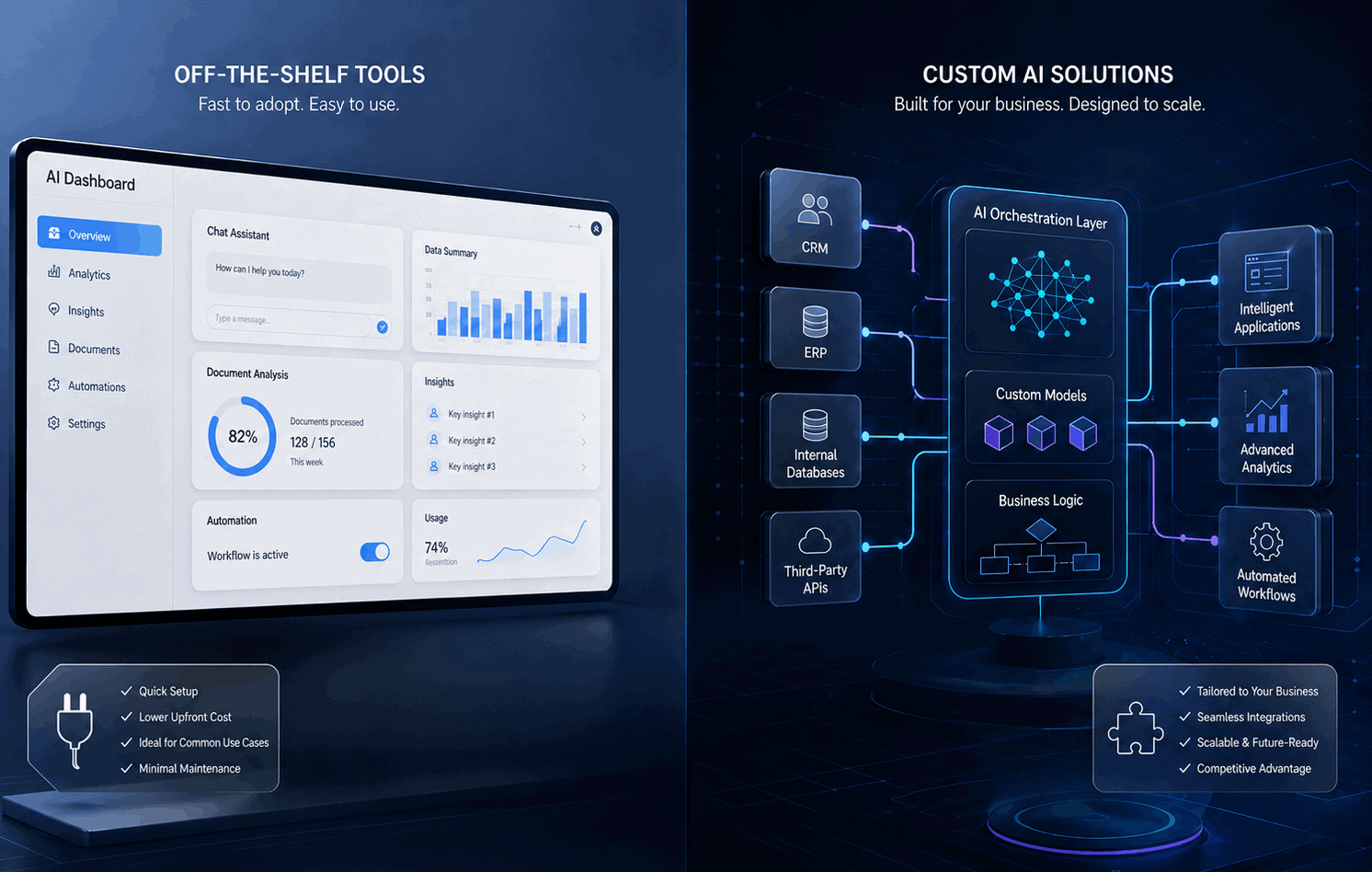
Off-the-shelf AI tools are ready-made platforms or software products designed for broad use across many businesses and industries.
These tools usually come with prebuilt features, standard interfaces, and subscription-based pricing. They are often marketed as fast and accessible solutions for companies that want to start using AI without a lengthy development process.
Examples may include:
- ✔️ AI writing and content tools
- ✔️ Customer support chatbots
- ✔️ AI meeting assistants
- ✔️ Predictive analytics dashboards
- ✔️ Workflow automation platforms with AI features
The main value of these tools is speed. Businesses can typically sign up, configure a few settings, and begin using them within days or weeks.
What Are Custom AI Solutions?
Custom AI solutions are systems designed and developed around a business’s specific needs. Instead of adapting operations to fit a generic tool, the technology is built to support the company’s existing processes, goals, users, and data environment.
A custom solution may involve:
- ✔️ AI-powered internal platforms
- ✔️ Custom recommendation engines
- ✔️ Industry-specific automation tools
- ✔️ Proprietary chat assistants trained on internal knowledge
- ✔️ AI models integrated into existing business systems
This approach is more tailored, but it also requires clearer planning, technical design, testing, and ongoing support. The upside is that the solution can be aligned more closely with how the business actually works.
The Core Difference: Flexibility vs Convenience
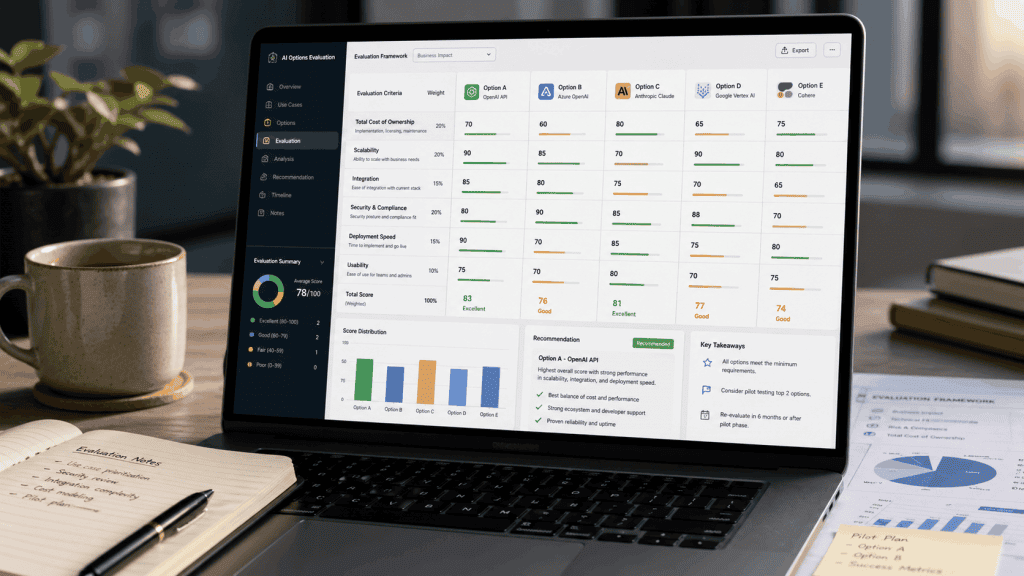
At the highest level, the choice often comes down to flexibility versus convenience.
Off-the-shelf tools are built for fast adoption and broad usability. They are convenient, easier to launch, and usually require less upfront investment.
Custom AI systems are built for fit, control, and long-term relevance. They take more effort to plan and implement, but they can solve more specific problems and create stronger differentiation.
That does not automatically make one better than the other. It means businesses need to evaluate the trade-offs in a practical way.
When Off-the-Shelf AI Tools Make Sense
There are many situations where an off-the-shelf platform is the smarter choice.
1. You need to move quickly.
If the goal is to start using AI as soon as possible, a ready-made platform can reduce setup time significantly. This can be helpful for pilot programs, early adoption, or fast-moving teams that want to test AI use cases before committing to larger investments.
2. Your use case is common and straightforward.
Some business needs do not require custom development. If you want AI support for meeting summaries, general content assistance, or basic chatbot workflows, widely available tools may already be sufficient.
3. You have a limited budget for initial rollout.
Subscription-based AI platforms usually have lower upfront costs than custom development. For smaller teams or businesses still exploring AI opportunities, this can lower the barrier to entry.
4. You do not need deep integration.
If the tool can operate independently without needing to connect heavily with your internal systems, a ready-made product may be enough.
When Custom AI Solutions Make More Sense
There are also clear situations where custom AI solutions create more value.
1. Your workflows are unique.
If your processes are specialized, highly regulated, or operationally complex, a generic tool may create friction rather than efficiency. A custom solution can be designed around your actual workflows instead of forcing teams to work around product limitations.
2. You need stronger integration with internal systems.
A major advantage of custom AI is the ability to structure the solution around business-specific data. This can improve relevance, accuracy, and business impact when compared with tools built for general use.
3. You want to use your own data strategically.
Subscription-based AI platforms usually have lower upfront costs than custom development. For smaller teams or businesses still exploring AI opportunities, this can lower the barrier to entry.
4. You need more control over security, governance, and performance.
For businesses handling sensitive data or operating in highly regulated industries, control matters. Custom-built solutions can offer better oversight over how data is processed, stored, accessed, and governed.
5. AI is part of your long-term competitive strategy.
If AI is expected to become a core part of your service delivery, product offering, or operational advantage, building something tailored may be a stronger long-term investment than depending entirely on third-party platforms.
AI Tools Comparison: Key Factors to Evaluate
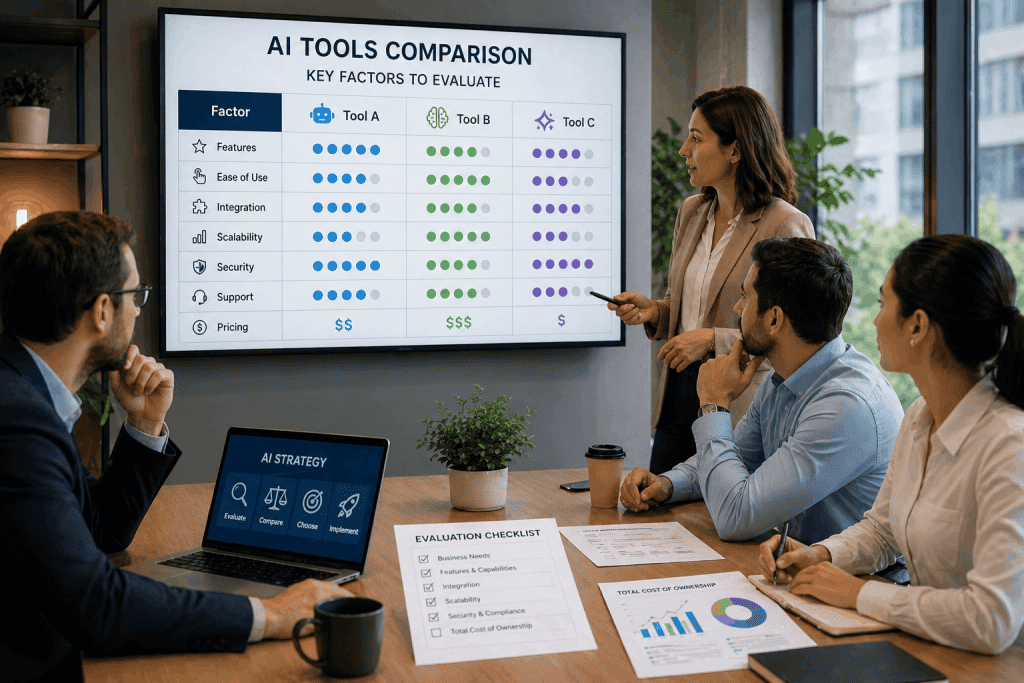
A proper AI tools comparison should go beyond basic pricing. Businesses should assess both short-term usability and long-term strategic fit.
Business Fit: Does the solution support the way your teams already work, or will your teams need to change their process to match the tool?
Speed to Deployment: How quickly do you need results? Off-the-shelf tools often win on deployment speed, while custom projects require more planning and build time.
Scalability: Will the solution still work as your operations grow, your data expands, and your needs become more complex?
Integration Requirements: Does the AI tool need to connect with other systems, platforms, or internal workflows? This is often where custom options become more valuable.
Cost Structure: Off-the-shelf tools may have lower upfront costs, but recurring subscription fees and usage-based pricing can add up over time. Custom solutions usually require more investment at the start, but they may provide better long-term value depending on the use case.
Data Control and Security: How much visibility and control do you need over your business data? This is especially important for companies operating in sectors with strict privacy, compliance, or governance standards.
User Adoption: Will your teams find the solution useful and practical? Even a technically strong AI product will underperform if employees do not trust it or find it difficult to use.
The Hidden Risks of Choosing the Wrong Option
The wrong AI decision does not always fail immediately. In many cases, the problems appear later.
A business might adopt a ready-made tool because it seems efficient, only to realize that it does not integrate well, cannot handle the required complexity, or creates data concerns. On the other hand, a company may begin a custom AI project without a clear use case, realistic scope, or implementation plan, which can lead to delays and wasted budget.
That is why the decision should not be framed as custom versus standard in a purely technical sense. It should be framed as a business decision tied to outcomes, processes, risk, and growth.
A Practical Way to Decide
If your business is still exploring AI, it may make sense to begin with a focused question:
What problem are we trying to solve, and how specific is that problem to our business?
If the problem is broad and common, an off-the-shelf product may be enough. If the problem is closely tied to your internal operations, customer experience, or proprietary advantage, a tailored solution may be worth the investment.
Another useful question is this:
Are we adopting AI as a supporting tool, or are we building AI into how the business creates value?
That distinction often reveals whether convenience or customization should come first.
Why Many Businesses End Up Using Both
In practice, the answer is not always one or the other.
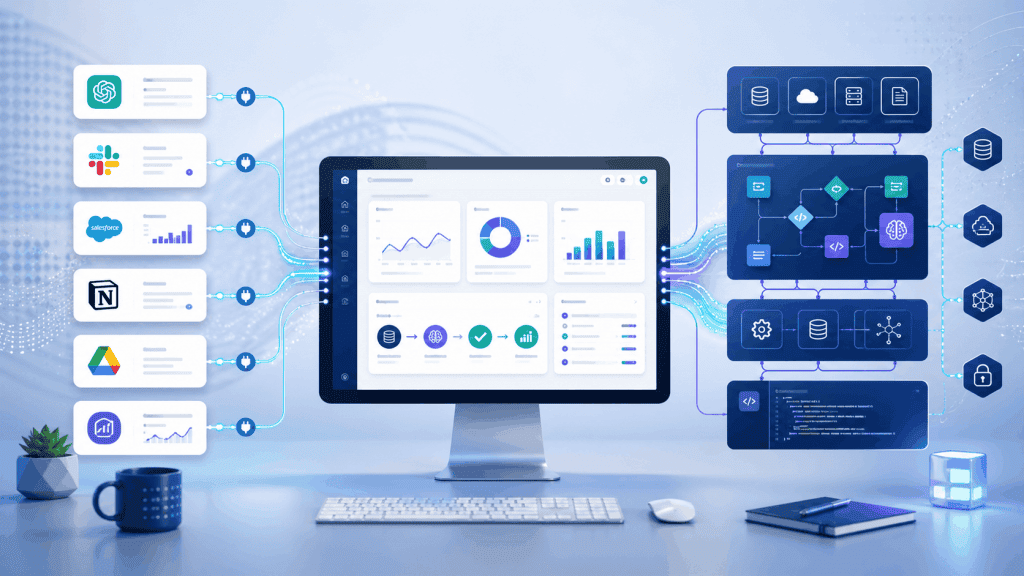
Some companies use off-the-shelf tools for general productivity while investing in custom AI solutions for areas that directly affect operations, customer experience, or competitive differentiation.
This hybrid approach can be practical. It allows businesses to move quickly where standard tools are enough, while still building tailored solutions where business impact is higher.
The key is to avoid treating every AI need the same way. Different use cases deserve different levels of investment and customization.
How the Right Development Partner Can Help
Choosing between ready-made AI platforms and tailored development is easier when the decision is grounded in business reality rather than hype.
A strong development partner can help by:
- ✔️ identifying the most practical AI opportunities
- ✔️ evaluating whether a custom or off-the-shelf route makes more sense
- ✔️ mapping integration requirements
- ✔️ planning a realistic rollout
- ✔️ building solutions that align with long-term business goals
This is especially important for businesses that want more than a quick AI experiment. The right partner can help turn AI adoption into something structured, useful, and scalable.
👉 Related Reading: How US Startups Use Offshore Staff Augmentation to Scale Faster
Conclusion
The best AI choice depends on what your business actually needs. Off-the-shelf tools can be effective for speed, accessibility, and common use cases. Custom-built solutions are often better suited for businesses that need stronger integration, more control, and a closer fit with how they operate.
A thoughtful AI tools comparison should not focus only on what is cheaper or faster today. It should also consider what will create the most value as your business grows. When AI becomes part of your long-term strategy, the difference between convenience and fit becomes much more important.
FAQs
What are custom AI solutions?
Custom AI solutions are AI systems designed around a business’s specific workflows, goals, users, and data. They are built to solve targeted problems rather than serve a broad general market.
Are off-the-shelf AI tools cheaper than custom AI solutions?
They often have lower upfront costs, but the long-term cost depends on usage, subscription pricing, limitations, and whether the tool can truly meet the business’s needs.
How do I know if my business needs a custom AI solution?
If your processes are unique, your integration needs are complex, or AI is becoming part of your long-term competitive strategy, a custom solution may be the better fit.
What should be included in an AI tools comparison?
A good AI tools comparison should look at business fit, deployment speed, scalability, integrations, cost structure, data control, and user adoption.
Can a business use both custom AI and off-the-shelf tools?
Yes. Many businesses use ready-made AI tools for general productivity and custom solutions for more strategic or business-specific use cases.
🚀 Is your business weighing ready-made platforms against custom AI solutions?
From strategy to development, Lanex can help you evaluate the right path and build AI systems that support real business outcomes.